
Chionea valga
Harris, 1841
snow fly
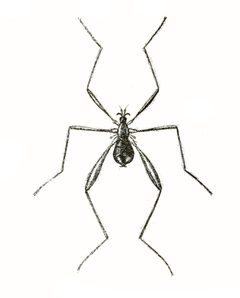
Chionea valga is a wingless crane fly commonly known as the snow fly. It is active during winter months, crawling across snow surfaces in cold conditions when most other insects are . are dark-bodied and lack wings entirely, with females storing in the thoracic cavity normally occupied by muscles. The occupies subnivean microhabitats—spaces beneath snow created by vegetation and rodent tunnels—where temperatures remain milder than surface conditions.
Pronunciation
How to pronounce Chionea valga: //kiˈoʊniə ˈvælɡə//
These audio files are automatically generated. While they are not always 100% accurate, they are a good starting point.
Identification
Distinguished from other crane flies by complete absence of wings in . Among Chionea , identification to species level requires examination of specific morphological characters not detailed in available sources; C. valga occurs in eastern North America. Dark coloration and winter surface activity on snow further distinguish it from virtually all other active insects in its .
Images
Habitat
Primarily subnivean environments: cavities beneath snow created by arching grass blades, leaf litter, and small mammal tunnels. Also found beneath leaf litter and in caves. These insulated microhabitats buffer against severe surface temperatures.
Distribution
Eastern North America: Canada (Alberta to Newfoundland) and USA (south to Minnesota, Wisconsin, Tennessee, North Carolina, and Virginia). Eastern occur in forested areas, particularly regions that experienced glaciation during the most recent ice age.
Seasonality
most commonly observed in October and November, and again in February and March. Active during winter when temperatures are above severe extremes but still cold.
Life Cycle
Poorly understood; laboratory rearing attempts have failed due to unknown larval food requirements. Female produces up to 194 , laid singly. Eggs hatch in 8 days to 3 weeks under laboratory conditions. Larvae feed and grow during summer months; occurs in fall. Larval mouthparts are fairly hardened, suggesting capacity for solid food intake, but specific diet remains unknown. lifespan may reach two months.
Behavior
crawl across snow surfaces during winter, often in sunny conditions. Occupies subnivean spaces for insulation from extreme cold. Susceptible to overheating; possesses glycerol-based antifreeze compounds and cold-adapted systems permitting function at temperatures lethal to most insects.
Ecological Role
Prey for small mammals (mice) and rock-crawlers (Grylloblattidae). Serves as intermediate for rodent tapeworms, completing a portion of the .
Human Relevance
Does not bite or sting humans. Occasionally encountered by winter hikers and outdoor enthusiasts. Subject of scientific interest due to extreme cold and unique .
Similar Taxa
- Chionea species (western)Western Chionea are mostly confined to mountain ranges, whereas C. valga occurs in eastern forested areas; species-level identification requires detailed morphological examination.
- Tipulidae (winged crane flies)All other crane flies possess wings in the stage; C. valga is uniquely wingless among commonly encountered limoniids.
- Snow fleas (Collembola)Often confused due to shared and winter surface activity; snow fleas are springtails, not flies, and possess a for jumping that snow flies lack.
Misconceptions
Despite similarity, snow flies do not bite, sting, or cause pain to humans. They are frequently confused with snow fleas (springtails), which are unrelated hexapods.
More Details
Cold tolerance physiology
Glycerol in body fluids acts as antifreeze, preventing ice crystal formation. Differing systems permit metabolic function at low temperatures that would incapacitate most insects.
Reproductive adaptation
Winglessness in females creates unoccupied thoracic space repurposed for storage, an unusual anatomical modification among Diptera.