
Chionea albertensis
Alexander, 1941
snow fly
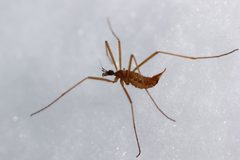
Chionea albertensis is a wingless crane fly in the Limoniidae, first described by Charles Paul Alexander in 1941. As a member of the 'snow fly' Chionea, it is adapted to cold environments and has been observed active on snow surfaces during winter months. The is known from western North America, with records from Alberta, British Columbia, and southward to Oregon, Idaho, and Montana. Like other Chionea species, it lacks wings and has modified traits associated with subnivean .
Pronunciation
How to pronounce Chionea albertensis: /kaɪˈoʊniə ælbərˈtɛnsɪs/
These audio files are automatically generated. While they are not always 100% accurate, they are a good starting point.
Identification
Chionea albertensis is distinguished from other Chionea by geographic distribution and presumably by subtle morphological characters used in Alexander's original description (1941). The sixteen North American Chionea species are generally similar in appearance; accurate identification to species level requires examination of specimens by a . Western species including C. albertensis are mostly confined to mountain ranges, whereas eastern species occur more broadly in forested areas. The species is smaller than winged crane flies and may be confused with other wingless insects such as grylloblattids (rock-crawlers), but differs in body form and use.
Images
Habitat
Mountain ranges of western North America. are found on snow surfaces but spend most of their time concealed in subnivean microhabitats: cavities beneath snow created by arching grass blades, leaf litter, and small mammal tunnels. These insulated environments provide milder temperatures than surface conditions. Also reported from fairly deep in caves.
Distribution
Western North America: Canada (Alberta, British Columbia) and USA (south to Oregon, Idaho, and Montana). Nearctic region.
Seasonality
Active during winter months. Chionea generally appear most commonly in October and November, and again in February and March. may live up to two months.
Life Cycle
The remains incompletely known. are present in winter. are laid singly; females can produce up to 194 eggs. Eggs take eight days to three weeks to hatch under laboratory conditions. Larvae feed and grow during summer months, with in fall. Larval diet is unknown; rearing attempts in laboratory have failed. Larvae have fairly hardened mouthparts suggesting ability to consume solid food.
Behavior
crawl on snow surfaces during winter, making them conspicuous despite normally cryptic habits. Occupies subnivean environment to avoid freezing. Has glycerol in body fluids acting as antifreeze, and modified systems allowing function at low temperatures. Susceptible to overheating. Every attempt to rear in laboratory has failed.
Ecological Role
Prey for small mammals (mice) and grylloblattids (rock-crawlers). Serves as intermediate for parasitic tapeworms of rodents: tapeworm consumed by snow fly larvae develop to cysticeroid stage, then transmitted to rodents when snow flies are eaten.
Human Relevance
Does not bite or sting humans. Encountered by hikers and naturalists in winter mountain environments. Subject of scientific interest due to cold mechanisms. No economic importance documented.
Similar Taxa
- Other Chionea speciesSixteen North American are morphologically similar; C. albertensis distinguished by western mountain distribution and subtle morphological characters from Alexander's 1941 description
- Grylloblattidae (rock-crawlers)Also wingless, cold-adapted, and found at high elevations in western North America, but differ in body form and are predatory on snow flies rather than competing with them
- Snow fleas (Collembola, Hypogastrura nivicola)Also active on snow in winter but are springtails (non-insects in traditional sense), much smaller, and use different locomotion ( for jumping)
Misconceptions
Snow flies are sometimes confused with snow fleas (springtails), but they are unrelated and differ in and . They do not bite or sting despite occasional public concern.
More Details
Cold adaptation
Glycerol acts as antifreeze in body fluids; modified systems permit function at low temperatures. Subnivean microhabitats provide thermal buffering.
Taxonomic history
Limoniidae was formerly treated as a of Tipulidae; Chionea is now placed in Limoniidae subfamily Chioneinae.