
Terellia
Robineau-Desvoidy, 1830
Species Guides
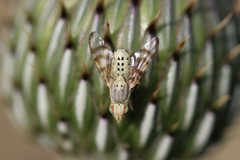
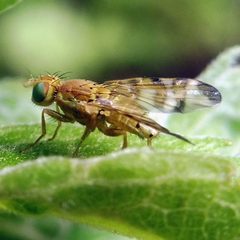
4- Terellia fuscicornis(Artichoke Fly)
- Terellia occidentalis
- Terellia palposa
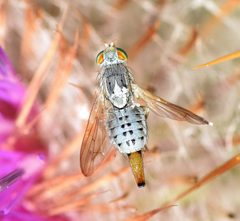
- Terellia ruficauda(Red-tailed Thistle Fly)
Terellia is a of fruit flies in the Tephritidae, comprising approximately 60 described distributed across the Palearctic region. Species in this genus are primarily associated with thistles and related plants in the Asteraceae family, with larvae developing in flower (capitula) of their plants. The genus includes several species groups (virens group, amberboae group, tarbinskiorum group) distinguished by morphological characters and host associations. Terellia ruficauda has been used as a agent for Canada thistle.
Pronunciation
How to pronounce Terellia: /tɛˈrɛli.a/
These audio files are automatically generated. While they are not always 100% accurate, they are a good starting point.
Identification
identification relies on wing pattern, body coloration, and male genitalia structure. The tarbinskiorum group species share three pairs of black shining spots on the . The virens group is characterized by specific wing and body coloration patterns, including entirely hyaline wings in some species. Male phallus structure, particularly the shape of the glans and tubular extension, provides critical diagnostic characters. Orange or yellow markings on the (katepisternum, meron, anepisternum) are present in some species groups.
Images
Habitat
are defined by plant distribution, primarily in grasslands, steppes, and open habitats supporting thistles and related Asteraceae. Mountain steppe has been documented for some .
Distribution
Palearctic distribution, with records from Europe, Russia, Central Asia (Kazakhstan, Uzbekistan), the Middle East (Iran, Armenia, Lebanon), and scattered records from North America (DK, NO, SE per GBIF). Specific show more restricted ranges: T. hajastanica is known only from Armenia; T. korneyevorum from Iran; T. barughii from Iran and Armenia.
Diet
diet unknown. Larvae feed on developing seeds and tissues within flower (capitula) of Asteraceae plants.
Host Associations
- Carduus - plantThistle ; for T. serratulae
- Cirsium - plantThistle including Canada thistle; for T. serratulae and T. ruficauda
- Picnomon - plant for T. serratulae; P. acarna-associated may represent distinct host race
- Centaurea - plantKnapweeds; for multiple including T. virens group (C. kotschyi, C. polypodiifolia, C. daralagoezica, C. spectabilis, C. takhtajanii), T. hajastanica (C. pseudoscabiosa subsp. glehnii), T. freidbergi, T. ivannikovi
- Echinops - plantGlobe thistle; for T. korneyevorum
- Amberboa - plant for amberboae group
- Psephellus - plantP. erivanensis recorded as for T. odontolophi
- Oligochaeta - plantO. divaricata recorded as for T. barughii
Life Cycle
Larvae develop within the capitula (flower ) of plants, feeding on developing seeds and floral tissues. occurs either within the capitulum or in plant stems. emerge from infested flower heads. Specific timing varies with host plant .
Behavior
Females oviposit into flower of plants. Host specificity varies: some are monophagous or oligophagous, while others show broader host ranges with potential host race formation.
Ecological Role
Seed of Asteraceae, potentially influencing plant . Some have been evaluated or employed as agents for thistles.
Human Relevance
Terellia ruficauda has been deployed as a agent for Canada thistle (Cirsium arvense), with larvae parasitizing seed and reducing plant reproductive output. Other have been investigated for control of yellow starthistle and related weeds. specificity testing is required before introduction as biocontrol agents due to risk of non-target effects.
Similar Taxa
- OrelliaShares scutal spot pattern with tarbinskiorum group but differs in male genitalia structure and plant associations
- UrophoraAnother tephritid associated with Asteraceae; some formerly confused with Terellia or used in similar biocontrol contexts
- Acanthiophilus tephritid also associated with thistles; range overlaps with some Terellia
More Details
Species groups
The contains several morphologically and ecologically distinct groups: the virens group (7+ species in Armenia and Russia, associated with Centaurea), the amberboae group (associated with Amberboa, distributed in Iran, Central Asia, and Russia), and the tarbinskiorum group (three species from Iran, characterized by specific scutal markings and male genitalia). These groupings reflect both phylogenetic relationships and plant associations.
Host race formation
Genetic and morphometric studies of T. serratulae in Lebanon demonstrate intraspecific variation correlated with plant use, with on Picnomon acarna showing over 3% mitochondrial divergence and distinct morphological traits. This suggests ongoing or incipient speciation via host race formation, complicating identification and host range prediction.
Taxonomic history
Terellia luteola was removed from synonymy with T. colon based on choice experiments and morphological analysis, highlighting the importance of experimental and molecular data in resolving boundaries in this .
Sources and further reading
- BugGuide
- Wikipedia
- GBIF taxonomy match
- iNaturalist taxon
- NCBI Taxonomy
- Catalogue of Life
- Revision of Terellia amberboae group of species (Diptera: Tephritidae)
- Terellia hajastanica, a new species of tephritid flies (Diptera: Tephritidae) associated with Centaurea pseudoscabiosa subsp. glehnii (Asteraceae) in Armenia
- A new species of Terellia (Diptera: Tephritidae) from Iran with a key to the species of the tarbinskiorum group
- New data on the morphology, distribution and host plants of three species of the Terellia virens group (Diptera: Tephritidae)
- First findings of two species of Tephritidae (Diptera) from Armenia, with a description of a new host-associated population of Terellia odontolophi Korneyev, 1993
- Genetic and morphometric variations in the Lebanese populations of the flower-head-infesting fruit fly, Terellia serratulae (Diptera: Tephritidae)
- Tephritids of knapweeds, starthistles and safflower: results of a host choice experiment and the taxonomy of Terellia luteola (Wiedemann) (Diptera: Tephritidae)