
Oxyna
Robineau-Desvoidy, 1830
Species Guides
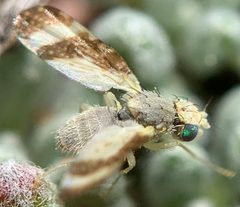
2Oxyna is a of tephritid fruit flies (Tephritidae) comprising at least 20 described . Members of this genus are associated with Asteraceae plants, with some species studied for their potential as agents against weeds. The genus has been documented in northern Europe including Denmark, Norway, and Sweden.
Pronunciation
How to pronounce Oxyna: /ˈɒksɪnə/
These audio files are automatically generated. While they are not always 100% accurate, they are a good starting point.
Identification
Oxyna can be distinguished from other tephritid by their association with Asteraceae plants and their stem-boring larval habits. Specific diagnostic morphological features for genus-level identification require examination of wing venation patterns and genitalia structure, best determined by taxonomic keys.
Images
Habitat
Associated with Asteraceae plants, particularly mugwort (Artemisia vulgaris). Larvae develop within stems of plants.
Distribution
Documented from Denmark, Norway, and Sweden based on occurrence records. Distribution likely broader across the Palearctic region given plant range.
Diet
Larvae feed internally on stem tissue of plants in the Asteraceae . feed on nectar and other liquid food sources, though specific adult diet is not well documented.
Host Associations
- Artemisia vulgaris - primary plantlarval development occurs within stems
Life Cycle
are deposited into plant stems. Larvae develop internally as stem borers, feeding on parenchyma tissue. occurs within the stem. is synchronized with host plant .
Behavior
Females exhibit plant selection , laying in stems of specific Asteraceae . Larvae are endophagous, completing development within plant stems.
Ecological Role
Herbivore specializing on Asteraceae; influenced by including Pteromalus parietinae (endoparasitoid) and Chlorocytus sp. (ectoparasitoid). Some investigated as potential agents for mugwort.
Human Relevance
Oxyna parietina has been evaluated as a candidate for of Artemisia vulgaris (common mugwort), an weed in some regions. No significant economic importance as a crop pest has been documented.
Similar Taxa
More Details
Parasitoid Complex
Oxyna parietina is attacked by at least two pteromalid . Pteromalus parietinae is an endoparasitoid, while Chlorocytus sp. is an ectoparasitoid. These can be significant mortality factors and their synchrony with the fly's affects .
Biocontrol Research
Research in Germany (Kiel region) established baseline and for Oxyna parietina as a potential biocontrol agent. Studies examined , abundance, and impacts to assess feasibility for mugwort management.
Sources and further reading
- BugGuide
- Wikipedia
- GBIF taxonomy match
- iNaturalist taxon
- NCBI Taxonomy
- Catalogue of Life
- The Bugs and the Bees: A Guide to Entomology Outreach, Even During a Pandemic
- Biologie, Ökologie und Parasitoide von Oxyna parietina L. (Dipt., Tephritidae), einem möglichen Kandidaten zur biologischen Bekämpfung von Artemisia vulgaris L.
- Thermodynamic analysis of the thermostable xylanase OXynA-M.