
Tephritis
Latreille, 1804
Species Guides
11Tephritis is a large of true fruit flies (Diptera: Tephritidae) comprising approximately 170 described , making it the sixth largest genus in the . Species occur across diverse climate zones from hot semidesert to tundra, with the greatest diversity in the Palearctic region. Most species are associated with Asteraceae plants, inhabiting inflorescences of several tribes including Cardueae, Cichorieae, Anthemideae, Inuleae, and Senecioneae. Some species cause gall formation on plants. The genus has been extensively studied for host-race formation and incipient speciation, particularly in T. conura and T. bardanae, which show genetic and morphological differentiation correlated with host-plant use.
Pronunciation
How to pronounce Tephritis: /ˈtɛf.rɪ.tɪs/
These audio files are automatically generated. While they are not always 100% accurate, they are a good starting point.
Identification
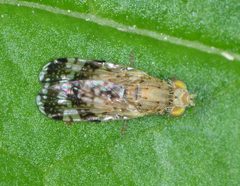
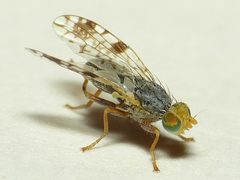
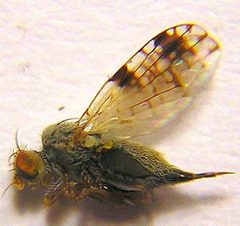
Tephritis can be distinguished from other Tephritinae fruit flies by the arrangement of setae on the body. Wing pattern is diagnostically important: most exhibit dark rays on R4+5 and M connected to the preapical dark spot or to each other (the " fork"), though some species have a solid apical crossband or isolated apical spots. Specific identification often requires examination of shape, spermathecae , and details of abdominal tergite coloration and setation.
Images
Habitat
occupy a wide range of climate types from hot semidesert to tundra. Most species inhabit the inflorescences of Asteraceae plants. specificity is largely determined by -plant distribution, with flies occurring in , sympatric, or parapatric settings depending on host plant ranges.
Distribution
Occurs throughout much of the world with greatest in the Palearctic region. Documented from Europe, northern Africa, western Asia, Central Asia (Kazakhstan, Kyrgyzstan), Iran, Armenia, Turkey, India (Kashmir), and China (three-river source region). One , T. candidipennis, occurs in North America.
Diet
Larvae are phytophagous, feeding within flowerheads of Asteraceae plants. Specific host associations documented for numerous include: Cirsium heterophyllum and C. oleraceum (T. conura); Arctium tomentosum and A. minus (T. bardanae); Cirsium arvense (T. cometa); Doronicum dolichotrichum (T. arsenii); Helichrysum sp. (T. heringinella); Cousinia spp. and Alfredia nivea (various species); and Aster varieties (T. angustipennis).
Host Associations
- Cirsium heterophyllum - larval T. conura race
- Cirsium oleraceum - larval T. conura race
- Cirsium arvense - larval T. cometa
- Arctium tomentosum - larval T. bardanae
- Arctium minus - larval T. bardanae
- Doronicum dolichotrichum - larval T. arsenii, tribe Senecioneae
- Helichrysum sp. - larval T. heringinella
- Cousinia spp. - probable larval swept from plants, T. admissa, T. cameo, T. gladius, T. ochroptera
- Alfredia nivea - larval T. tatarica reared from this
- Aster spp. - larval T. angustipennis
Life Cycle
Larvae develop within flowerheads of Asteraceae plants. Some cause gall formation. occurs within the flowerhead or gall. emerge to mate and oviposit into new host flowerheads. Host-race formation has been documented in several species, with on different host plants showing genetic differentiation despite sympatric distributions.
Behavior
Females oviposit into flowerheads of plants. Host-associated mating has been observed in T. bardanae, with behavioral differences at oviposition indicating partial reproductive isolation between host races. T. conura shows spatial and seasonal patterns in distribution correlated with host plant . Some exhibit host fidelity that contributes to reproductive isolation and potential .
Ecological Role
Phytophagous insects that influence Asteraceae reproductive success through flowerhead . Some act as gall-formers, inducing structural changes in plants. Serve as prey for and other natural enemies. Host-race dynamics provide a model system for studying ecological speciation and the role of plant-insect interactions in diversification.
Human Relevance
Some may impact Asteraceae crops or medicinal plants (e.g., Cirsium arvense used as tonic and for treating diarrhea and tuberculosis). The serves as an important model for evolutionary studies of -race formation and . Taxonomic expertise on Tephritis contributes to broader fruit fly identification capacity for agricultural pest management, as demonstrated by training workshops involving Tephritis .
Similar Taxa
- TrupaneaTephritis kukunoria was transferred to Trupanea based on examination; distinguished by wing venation and body setation patterns
- HeringinaTephritis heringinella shares shiny black abdominal tergites with Heringina but differs in shape and wing pattern details; possible close phylogenetic relationship
- Other Tephritinae generaDistinguished from other Tephritinae by diagnostic body setal arrangement and characteristic wing pattern configurations
More Details
Taxonomic research significance
Severyn Korneyev completed a doctoral dissertation on revision of Western Palaearctic Tephritis (2016) and published a of the in 2020. Multiple revisionary works have addressed groups defined by wing pattern: isolated spots (20 species), solid apical crossband (11 species). Several new species and described from Turkey, Iran, Armenia, Kyrgyzstan, and Central Asia.
Evolutionary significance
T. conura and T. bardanae are prominent models for studying via -race formation. T. conura on Cirsium heterophyllum and C. oleraceum show genetically determined ovipositor length differences (8.4% absolute, 10.3% relative) adapted to host flower- size. T. bardanae populations on Arctium tomentosum and A. minus show significant differentiation in , mtDNA haplotypes, and wing size, with host-plant association explaining more genetic variance than geographic location.
Collection and identification challenges
Many undescribed species are known from specimen collections. Accurate identification requires examination of genitalic structures (, spermathecae) and wing pattern details. using COI sequences has been applied to genetic studies in China, showing utility for distinguishing populations and .
Sources and further reading
- BugGuide
- Wikipedia
- NCBI Taxonomy
- Catalogue of Life
- CDFA to Host Fruit Fly Workshop, Free to Participants | Bug Squad
- Fly Diversity Explained With Ukrainian Colors | Bug Squad
- Learning About Wasps and Other Insects | Bug Squad
- Speciation via Differential Host–Plant Use in the Tephritid Fly Tephritis conura
- Revision of species of the genus Tephritis Latreille 1804 (Diptera: Tephritidae) with entire apical spot
- A new species of Tephritis Latreille, 1804 (Diptera: Tephritidae) from Turkey
- Host Race Formation in Tephritis conura: Determinants from Three Trophic Levels
- On the Taxonomic Revision of the Genus Tephritis (Diptera, Tephritidae): New Synonymy
- A New Species of the Genus Tephritis (Diptera, Tephritidae) with Shining Abdominal Tergites from Kyrgyzstan
- Spatial and Seasonal Patterns in the Egg Distribution of Tephritis conura (Diptera: Tephritidae)
- Revision of the Old World species of the genus Tephritis (Diptera, Tephritidae) with a pair of isolated apical spots
- Morphological adaptation in host races of Tephritis conura
- Rayed Thistle Fly Tephritis cometa Loew (Diptera: Tephritidae) a new record to India
- The role of geographic setting on the diversification process among Tephritis conura (Tephritidae) host races
- Palearctic species of the genus Tephritis (Diptera, Tephritidae) associated with plants of the tribe Senecioneae (Asteraceae)
- Genetic and morphological differentiation in Tephritis bardanae (Diptera: Tephritidae): evidence for host-race formation
- Insect resistance responses of ten Aster varieties to damage by Tephritis angustipennis in the three rivers source region of China.
- Population genetic diversity and structure of Tephritis angustipennis and Campiglossa loewiana (Diptera: Tephritidae) based on COI DNA barcodes in the three-river source region, China.