
Hybomitra lasiophthalma
(Macquart, 1838)
Orange-sided Horse Fly
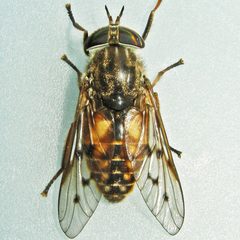
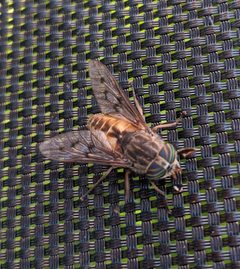
Hybomitra lasiophthalma, commonly known as the Orange-sided Horse Fly, is a of biting fly in the Tabanidae. It occurs in northeastern North America, with documented records from Vermont and broader distributions across Canada and the United States. Like other horse flies, females are blood-feeders while males feed on nectar. The species is one of many in the diverse Hybomitra, which contains numerous North American horse fly species.
Pronunciation
How to pronounce Hybomitra lasiophthalma: /haɪboʊˈmaɪtrə læsaɪˈɒfθælmə/
These audio files are automatically generated. While they are not always 100% accurate, they are a good starting point.
Identification
Distinguished from other horse flies by the orange coloration on the lateral sides of the , which gives rise to its . The specific epithet 'lasiophthalma' refers to hairy , a trait useful for differentiation from some . Accurate identification to level typically requires examination of eye patterns, abdominal coloration, and genitalic structures.
Images
Distribution
Canada and the United States. Documented occurrence records include Vermont, USA.
Diet
Females are blood-feeders, requiring vertebrate blood for development. Males feed on nectar and do not blood-feed.
Ecological Role
Females function as biting pests of mammals, including livestock and humans. Potential mechanical of due to blood-feeding and mouthpart structure, though specific vector competence for this is not well documented.
Human Relevance
Biting pest capable of delivering painful bites to humans and livestock. May cause nuisance and reduced productivity in affected animals. No specific economic or medical significance documented beyond general horse fly impacts.
Similar Taxa
- Hybomitra hineiCongeneric horse fly; males of H. hinei hold the recorded speed record for fastest flying insect (89 mph), though this is a behavioral trait of the rather than a morphological distinction from H. lasiophthalma
- Other Hybomitra speciesNumerous share general horse fly ; H. lasiophthalma distinguished by orange lateral abdominal markings and hairy
More Details
Taxonomic Note
Originally described by Macquart in 1838. The Hybomitra is part of the tribe Tabanini within Tabaninae, representing one of the most -rich genera of horse flies in the Holarctic region.
Observation Data
iNaturalist reports 457 observations, indicating moderate documentation effort and detectability relative to other horse fly .