
Esenbeckia
Rondani, 1863
horse-fly
Species Guides
3- Esenbeckia delta
- Esenbeckia incisuralis(green-eyed horse fly)
- Esenbeckia tinkhami
Esenbeckia is a of horse-flies ( Tabanidae) established by Rondani in 1863. Members are characterized by large, often vividly colored and robust body form typical of tabanid flies. The genus is distinct from the plant genus of the same name (family Rutaceae), which was described earlier by Kunth. within Esenbeckia are found in the Americas and are , fast-flying insects.
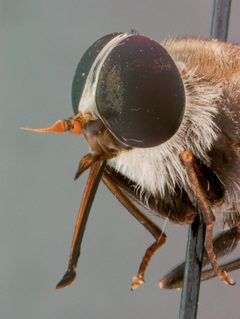
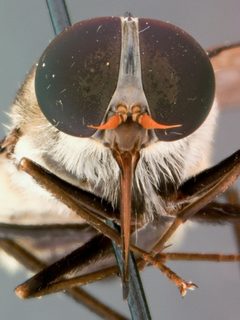
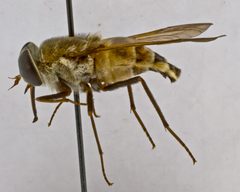
Pronunciation
How to pronounce Esenbeckia: /ˌɛsɛnˈbɛkiə/
These audio files are automatically generated. While they are not always 100% accurate, they are a good starting point.
Identification
Distinguished from other horse-fly by combination of structure, scutellar shape, and abdominal patterning. Esenbeckia incisuralis specifically identified by brilliant emerald-green eyes in males and distinctive abdominal markings. Separation from similar tabanid genera (e.g., Tabanus, Hybomitra) requires examination of wing venation, structure, and genitalia.
Images
Appearance
Large, robust flies with prominent that are often brilliantly colored—emerald green in males of some . may meet dorsally in males and are separated in females. Body typically stout with strong legs adapted for perching and rapid . Wings clear or slightly tinted, with characteristic venation of Tabanidae.
Habitat
Open including prairies, grasslands, and woodland edges. Often associated with areas near water sources required for larval development. frequently found on flowers where they feed on nectar.
Distribution
New World distribution, primarily in North America (United States, Mexico) and Central and South America. Specific records from Oklahoma, Texas, and Arizona in the United States.
Seasonality
activity observed during summer months (June–August) in temperate regions. Activity coincides with flowering of nectar sources and warm weather conditions favorable for .
Diet
feed on nectar from flowers. Females are blood-feeding on vertebrate ; males do not blood-feed.
Host Associations
- various mammals - blood females only; specific poorly documented
Life Cycle
Complete with aquatic or semi-aquatic larval stages. laid on vegetation near water. Larvae predatory in moist soil or aquatic environments. in soil. emerge in summer.
Behavior
Fast, powerful fliers. Males often perch on vegetation and await passing females. Both sexes visit flowers for nectar. Females pursue for blood meals with persistent, aggressive attack typical of horse-flies. Visual hunters using large to locate hosts and mates.
Ecological Role
serve as during nectar feeding. Larvae are in aquatic and soil . Females act as biting pests and potential to mammals.
Human Relevance
Females are significant biting pests of humans and livestock, causing painful bites and potential secondary . Not known as primary of major human , but mechanical transmission of possible. Attracted to movement and dark colors.
Similar Taxa
- TabanusBoth are large horse-flies with similar body plan; distinguished by structure, scutellar shape, and genitalia
- HybomitraSimilar size and coloration; separated by wing venation details and abdominal patterning
- Esenbeckia (plant genus)Homonym—completely unrelated of flowering plants in Rutaceae; no biological connection
Misconceptions
May be mistaken for hover flies (Syrphidae) due to flower-visiting and large , but distinguished by single pair of wings (Diptera), larger size, and biting mouthparts in females.
More Details
Nomenclatural note
The name Esenbeckia is a homonym, shared with a plant genus described by Kunth in 1821. The fly genus was established later by Rondani in 1863 and is valid under zoological . The two genera are unrelated and occur in entirely different kingdoms.
Esenbeckia incisuralis
One well-documented , E. incisuralis, has been specifically noted for its striking emerald-green male and occurrence in Oklahoma and Texas. This species was initially mistaken for a syrphid fly by observers due to its flower-visiting and eye coloration.