
Ocyptamus dimidiatus
(Fabricius, 1781)
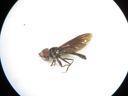
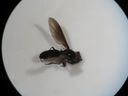
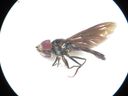
Ocyptamus dimidiatus is a hover fly ( Syrphidae) in the tribe Syrphini. The has been recorded across much of South America and has been introduced to Hawaii. It is one of numerous species in the diverse Ocyptamus, which can be challenging to distinguish from related genera such as Toxomerus and Allograpta.
Pronunciation
How to pronounce Ocyptamus dimidiatus: /oʊˈsɪp.tə.məs ˌdaɪ.mɪˈdaɪ.eɪ.təs/
These audio files are automatically generated. While they are not always 100% accurate, they are a good starting point.
Identification
Ocyptamus can be distinguished from the similar Pseudodoros by wing markings: Ocyptamus species have at least faint dark markings on the wings, often a bold leading edge. They may be confused with Toxomerus and Allograpta, though Ocyptamus species lack the distinct banded patterns seen in some Baccha species. Separation from other Ocyptamus species requires examination of characters on the lateral and portions of the .
Images
Distribution
Native to South America with records from Brazil (Acre, Alagoas, Amazonas, Amapá, Bahia, Ceará, Distrito Federal, Espírito Santo, Goiás, Maranhão, Minas Gerais, Mato Grosso do Sul, Mato Grosso, Pará, Paraíba, Pernambuco, Piauí, Paraná, Rio de Janeiro, Rio Grande do Norte, Rondônia, Roraima, Rio Grande do Sul, Santa Catarina, Sergipe, São Paulo, Tocantins), Colombia (Piedecuesta), and Norway (likely an error or introduced record). Introduced and established in Hawaii, United States.
Similar Taxa
- Pseudodoros clavatusSimilar -mimicking appearance, but Ocyptamus has dark wing markings while Pseudodoros lacks them
- ToxomerusExtremely similar ; Ocyptamus distinguished by wing markings and thoracic characters
- AllograptaSimilar body plan and coloration; requires examination of thoracic characters for separation
- BacchaSome have banded not typical of Ocyptamus
More Details
Taxonomic Note
The Ocyptamus is highly diverse in the Neotropics with over 144 according to some estimates. Species-level identification often requires examination of morphological characters not visible in standard photographs.