
Eupeodes flukei
(Jones, 1917)
Fluke's Aphideater
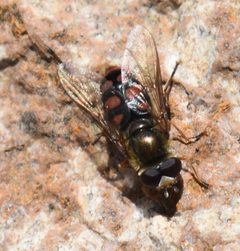
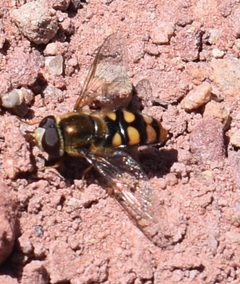
Eupeodes flukei is a of syrphid fly commonly known as Fluke's Aphideater. As a member of the Syrphinae, its larvae are , contributing to natural pest control in gardens and agricultural settings. are that visit flowers for nectar. The species exhibits typical hover fly characteristics including -mimicking appearance, hovering , and large .
Pronunciation
How to pronounce Eupeodes flukei: //juːˈpiː.oʊˌdiːz ˈfluːkaɪ//
These audio files are automatically generated. While they are not always 100% accurate, they are a good starting point.
Identification
can be distinguished from bees and by: single pair of wings versus two pairs in Hymenoptera; very short versus longer, often elbowed antennae in bees/wasps; hovering capability; and sponging mouthparts versus chewing . Within Eupeodes, precise identification to level requires examination of subtle morphological features including abdominal pattern details and male genitalia. The "Fluke's Aphideater" distinguishes it from .
Images
Habitat
Found in garden , agricultural settings, and natural areas supporting . Associated with flowering plants that provide nectar for and vegetation hosting aphid colonies for larval development. Observed on rosebushes and pine needles where aphids occur.
Distribution
Documented in North America. Specific range details limited by sparse observation records (7 observations in iNaturalist database as of source date).
Seasonality
active during spring and fall when peak. This seasonal pattern aligns with the requirements of larval aphid .
Diet
Larvae are obligate of aphids. feed on nectar and pollen from flowers.
Host Associations
- Aphids (Aphidoidea) - larval preyLarvae feed exclusively on aphids; females lay in or near colonies
Life Cycle
Complete with four stages: , larva, pupa, . Female lays eggs in or near colonies. Larva passes through three instars, molting between each, feeding on aphids throughout. Final instar into pupal stage, forming pear-shaped pupa attached to substrate. Adult emerges from pupal case. time and number of generations per year not documented for this .
Behavior
exhibit characteristic hovering . Larvae are cryptic, remaining motionless to avoid detection while hunting aphids. Adults visit flowers for nectar and pollen, serving as .
Ecological Role
Larvae function as agents of , reducing pest pressure in gardens and crops without chemical intervention. contribute to pollination of flowering plants.
Human Relevance
Beneficial insect for gardeners and agriculture. Larval provides natural pest control. pose no threat—they cannot sting despite -like appearance. Conservation of larvae recommended over chemical aphid control.
Similar Taxa
- Syrphus speciesSimilar abdominal banding and ; distinguished by subtle pattern differences and genitalia structure
- Allograpta speciesSmaller syrphine flies with different abdominal pattern; larvae also but separable by size and thoracic markings
- Toxomerus speciesSmaller, more delicate syrphids with distinct wing venation; often have metallic coloration
- Eupeodes americanus with overlapping range; separation requires detailed examination of abdominal pattern and male terminalia
More Details
Taxonomic note
Originally described as Syrphus flukei by Jones in 1917; later transferred to Eupeodes. The specific epithet honors an individual (Fluke), consistent with the .
Observation scarcity
Despite ecological importance as an , this remains poorly documented with only 7 observations in iNaturalist at time of source, suggesting either genuine rarity, identification difficulty, or underreporting.