
Epistrophe grossulariae
(Meigen, 1822)
Black-horned Smoothtail
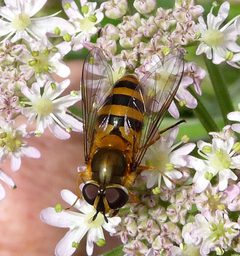
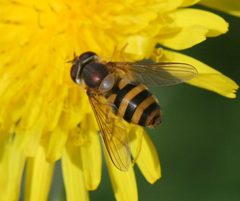
Epistrophe grossulariae is a Holarctic hoverfly in the Syrphidae, commonly known as the Black-horned Smoothtail. It is a medium-sized syrphid fly with distinctive morphological features that distinguish it from . The species has been well-documented across Europe with substantial observational records.
Pronunciation
How to pronounce Epistrophe grossulariae: /ɛˈpɪstrəfi ˌɡrɒsʊˈlɛəriˌaɪ/
These audio files are automatically generated. While they are not always 100% accurate, they are a good starting point.
Identification
Distinguished from similar Epistrophe by the entirely black and (the 'black-horned' trait). Differs from Epistrophe eligans by abdominal patterning: E. grossulariae has more uniform, less extensively yellow-marked tergites. Separated from Epistrophe nitidicollis by thoracic coloration and leg markings. Male genitalia provide definitive identification where examination is possible.
Images
Appearance
Medium-sized hoverfly with a smooth, somewhat elongated . The exhibits the characteristic 'smoothtail' of the Epistrophe, with relatively unmarked tergites. are black with distinctive black , contributing to the 'Black-horned'. Wing venation includes a characteristic loop in the R4+5 typical of Syrphinae.
Habitat
Associated with deciduous woodland edges, hedgerows, and scrubland. frequent flowering vegetation in semi-open . Larval habitat inferred from related : likely arboreal, associated with colonies on trees and shrubs.
Distribution
Holarctic distribution. Well-documented in Europe, with confirmed presence in Belgium (Flanders, Brussels-Capital Region, Walloon Region). Records span northern and central Europe; exact eastern and North American limits require verification.
Seasonality
period primarily late spring through summer, with peak activity typically June–August in temperate regions. Exact varies with latitude.
Life Cycle
Complete with , larva, pupa, and stages. Larvae are presumed based on -level traits in Syrphini, though direct documentation for this is limited.
Behavior
visit flowers for nectar and pollen. typical of hoverflies: hovering capability with rapid directional changes. Males exhibit territorial patrolling behavior near sunlit vegetation.
Ecological Role
contribute to pollination through flower visitation. Larval stage likely functions as , providing of tree-dwelling aphid .
Human Relevance
No direct economic significance. Valued as and potential biocontrol agent. Frequently recorded by citizen scientists, contributing to hoverfly monitoring programs.
Similar Taxa
- Epistrophe eligansSimilar size and general appearance, but E. eligans has more extensively yellow-marked abdominal tergites and partially pale .
- Epistrophe nitidicollisOverlapping distribution and ; distinguished by thoracic dorsum coloration and leg patterning.
- Epistrophe melanostomaClose with subtle differences in facial markings and genitalia structure.
More Details
Taxonomic history
Originally described as Syrphus grossulariae by Meigen in 1822, later transferred to Epistrophe. The basionym reflects early classification within the broader Syrphus concept.
Observation frequency
Over 3,000 observations documented on iNaturalist, indicating relatively common status in well-sampled regions and strong citizen science engagement.