
Epistrophe nitidicollis
(Meigen, 1822)
Straight-banded Smoothtail
Epistrophe nitidicollis is a hoverfly with a broad Holarctic distribution spanning Europe, North America, and northern Asia. are medium-sized with distinctive yellow facial markings and a black-and-yellow banded . The species is strongly associated with deciduous woodland where larvae prey on aphids. Adults visit diverse flowering plants including umbellifers and early spring bloomers.
Pronunciation
How to pronounce Epistrophe nitidicollis: //ɛˈpɪstroʊfi nɪˌtɪdɪˈkoʊlɪs//
These audio files are automatically generated. While they are not always 100% accurate, they are a good starting point.
Identification
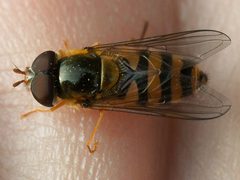
Distinguished from the similar Epistrophe melanostoma by being slightly narrower in build and having a black band on tergite 5 (absent in E. melanostoma). The black-haired scutellum also separates it from E. melanostoma. Male genitalia figured by Hippa (1968) provide definitive identification.
Images
Appearance
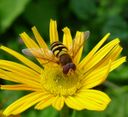
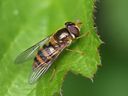
Medium-sized hoverfly with wing length 8–11.25 mm. wide, clear yellow, lightly dusted at margin. blackish and shiny. Tergites black and yellow. Legs yellow except dark . Scutellum black-haired. Tergite 5 with black band. Slightly narrower than similar E. melanostoma.
Habitat
Deciduous forest, scrub, and maquis vegetation. Arboreal, descending to visit flowers. Associated with woodland edge and semi-open within forested landscapes.
Distribution
Holarctic: Palearctic and Nearctic regions. Europe from Fennoscandia south to Iberia, Ireland east through North, Central and South Europe into Russia and Siberia to the Pacific coast (Kamchatka, Sakhalin Island). North America from Alaska south to California and South Carolina. Recorded from northern Iran.
Seasonality
period May to June; earlier in southern Europe, later at higher altitudes and northerly latitudes. Collected in Iran from March to August.
Diet
Larvae feed on aphids. visit flowers for nectar and pollen, including white umbellifers, Caltha, Cistus, Euphorbia, Prunus, Ranunculus, Rubus, and Taraxacum.
Host Associations
- Aphids - preyLarval food source
- Umbelliferae - flower visitorWhite umbellifers specifically mentioned
- Caltha - flower visitor
- Cistus - flower visitor
- Euphorbia - flower visitor
- Prunus - flower visitor
- Ranunculus - flower visitor
- Rubus - flower visitor
- Taraxacum - flower visitor
Life Cycle
Complete with , larval, pupal, and stages. Larva described and figured by Dusek and Laska (1959). Larval stage predatory on aphids. likely occurs in soil or leaf litter, though specific details not documented.
Behavior
Arboreal that descends to visit flowers. active during spring months, with period varying geographically.
Ecological Role
Larvae function as , contributing to in woodland . serve as of early spring flowering plants.
Human Relevance
Potential agent through larval . contribute to pollination of wild and cultivated plants. Subject of entomological research and faunistic surveys.
Similar Taxa
- Epistrophe melanostomaVery similar in appearance; E. nitidicollis is slightly narrower and has black band on tergite 5 and black-haired scutellum, which E. melanostoma lacks
More Details
Taxonomic history
Originally described as Syrphus nitidicollis by Meigen in 1822; later transferred to Epistrophe. Male genitalia documented by Hippa (1968), larval morphology by Dusek and Laska (1959).
Collection methods
Collected using in Iran study; likely captured by hand netting or pan trapping at flowers in other regions.