
Platycheirus
Lepeletier & Serville, 1828
Sedgesitters
Species Guides
13- Platycheirus coerulescens(Hooked Sedgesitter)
- Platycheirus confusus(Confusing Sedgesitter)
- Platycheirus hyperboreus(Pearly Sedgesitter)
- Platycheirus kelloggi(Broad-bodied Sedgesitter)
- Platycheirus nearcticus(Nearctic Broadhand Sedgesitter)
- Platycheirus obscurus(Eastern Forest Sedgesitter)
- Platycheirus quadratus
- Platycheirus russatus(California Sedgesitter)
- Platycheirus scambus
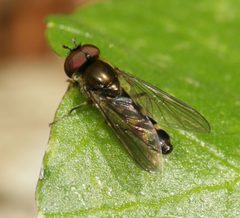
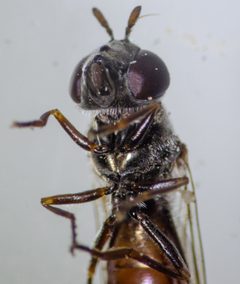
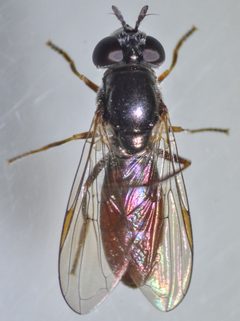
Platycheirus is a large of hoverflies ( Syrphidae) commonly known as sedgesitters. The genus was established in 1828 and is primarily Holarctic in distribution, with approximately 110 in the Palearctic and 70 in the Nearctic region. Species are slender, small to medium-sized flies, often with distinctive leg modifications in males used for species identification.
Pronunciation
How to pronounce Platycheirus: //ˌplætɪˈkaɪrəs//
These audio files are automatically generated. While they are not always 100% accurate, they are a good starting point.
Identification
Males are identified primarily by leg modifications, especially the front legs where tibia and may be dilated and colored. Some females have unique abdominal markings that aid identification, but many females are difficult or impossible to distinguish to . The combination of slender body, lack of bristles, high-placed , and wing venation (R-M crossvein before middle of , weak spurious ) helps distinguish the from other syrphids.
Images
Habitat
and temperate regions; occur in diverse from Arctic tundra (half of Nearctic species in Yukon, Northwest Territories, or Alaska) to temperate zones. Larvae occur in ground layer of leaf litter.
Distribution
Primarily Holarctic with strong component. Palearctic: approximately 110 . Nearctic: 70 species, with at least 23 species also occurring in Palearctic. Present in Mexico, Central and South America, Europe, Asia, and Southeast Asia. Absent from Australia, Indonesia, and New Guinea.
Seasonality
Active primarily May through early October in temperate regions, with peak activity before noon. Activity optimal between 13–23°C.
Diet
feed on nectar and pollen from flowers. Larvae are , ranging from to on one or two specific aphid .
Behavior
with unimodal activity pattern peaking before noon. Activity strongly temperature-dependent, optimal at 13–23°C; correlates negatively with temperature. Most active at 50–80% relative humidity. Both sexes visit flowers for nectar and pollen with similar handling times; morning handling times are longer than afternoon. Foraging speed varies among without apparent phylogenetic constraint.
Ecological Role
Important plant that frequently visit flowers of many plant . Larvae serve as agents as .
Human Relevance
Potential biocontrol agents due to larval . contribute to pollination of flowering plants. Subject of taxonomic study due to identification challenges, especially for females.
Similar Taxa
- Other SyrphinaePlatycheirus distinguished by combination of slender body, lack of bristles, high-placed with third segment longer than wide, and specific wing venation (R-M before middle of , weak spurious )
- MelanostomaFormerly confused with Platycheirus; distinguished by male genitalia and leg characters
More Details
Taxonomic history
Type of is Syrphus scutatus Meigen. Genus has been subject to extensive taxonomic revision with multiple diagnostic keys developed for different regions including Nearctic, European, Japanese, Taiwanese, and Russian Far East fauna.
Identification challenges
Female Platycheirus are notoriously difficult to identify, with some impossible to distinguish morphologically. This has prompted development of sequencing approaches for species discrimination, particularly in Taiwan where 63 species have been sequenced.