
Ornidia obesa
(Fabricius, 1775)
Green Jewel Fly
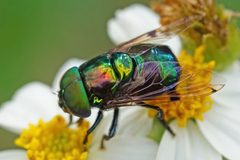
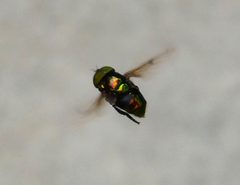
Ornidia obesa is a metallic green syrphid fly widely distributed across the Americas and introduced to the Old World. are frequently observed in association with decomposing organic matter, particularly animal and compost. The has been documented as a for pteromalid and is noted for harboring bacteria of public health significance.
Pronunciation
How to pronounce Ornidia obesa: /ɔːrˈnɪdiə oʊˈbiːsə/
These audio files are automatically generated. While they are not always 100% accurate, they are a good starting point.
Images
Habitat
Found in environments with decomposing organic matter, particularly poultry farms and areas with accumulated animal . In Brazil, documented in barns with earthen floors where chicken feces accumulated under cages, varying in moisture from pasty to firm consistency.
Distribution
Extensively distributed in the Americas; introduced to the Old World during the 19th century via commerce. Documented in Brazil (Goiás state, Morrinhos), with records across multiple Brazilian states including AC, AL, AM, AP, BA, CE, DF, ES, GO, MA, MG, MS, MT, PA, PB, PE, PI, PR, RJ, RN, RO, RR, RS, SC, SE, SP, and TO. Also recorded in Ecuador (Reserva Ecológica Arenillas) and the Galápagos Islands.
Host Associations
- Pachycrepoideus vindemmiae - Pteromalidae; emerged from pupae collected in chicken , 5.1% rate
- Spalangia cameroni - Pteromalidae; emerged from pupae collected in chicken , 5.1% rate
Life Cycle
Overwinters as pupae. Pupal stage subject to by pteromalid . In Brazilian study, pupae extracted from chicken by water flotation and reared individually; flies or emerged from these pupae.
Ecological Role
Flies proliferate in manure and decomposing organic matter. Subject to by pteromalid . have been noted to harbor bacteria of public health importance, suggesting potential role in bacterial transmission.
Human Relevance
Documented in poultry farm environments where proliferation in chicken may present concerns. carry bacteria of public health importance. Subject to efforts using .
Sources and further reading
- BugGuide
- Wikipedia
- GBIF taxonomy match
- iNaturalist taxon
- NCBI Taxonomy
- Catalogue of Life
- Western Lubber Grasshopper
- Species Records and Accounts
- Wyoming Distribution Atlas
- Grasshopper Collections and Survey
- Meloidae Holdings | Entomology Research Museum
- Clearwinged Grasshopper
- Parasitoides de Ornidia obesa Fabricius (Diptera: Syrphidae) coletados em fezes de galinha no Brasil