
Ornidia
Le Peletier & Audinet-Serville, 1828
jewel flies
Species Guides
1- Ornidia obesa(Green Jewel Fly)
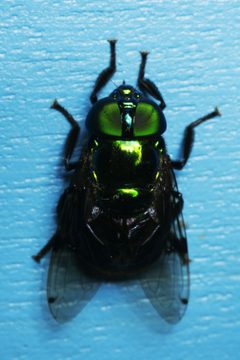
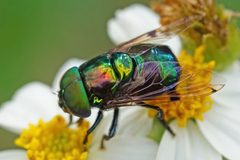
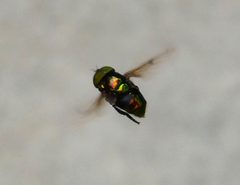
Ornidia is a small of metallic hoverflies (Syrphidae) native to the New World. range from 2.3–4.2 mm in body length and display distinctive metallic coloration. Ornidia obesa, the most widespread species, has been introduced to the Pacific, Asia, and Africa through human commerce. The genus comprises four described species.
Pronunciation
How to pronounce Ornidia: //ɔrˈniːdiə//
These audio files are automatically generated. While they are not always 100% accurate, they are a good starting point.
Identification
Small to mid-sized hoverflies with metallic green, blue, or bronze . Body length 2.3–4.2 mm. Distinguished from other metallic syrphids by combination of small size, New World distribution (native range), and specific wing venation patterns characteristic of Volucellini. Ornidia obesa can be recognized by its robust body form and extensive distribution outside native range.
Images
Habitat
Native occur in various New World environments. Ornidia obesa has been documented breeding in accumulated chicken in poultry farms, particularly under cages in commercial houses with earthen floors.
Distribution
All to the New World. Ornidia obesa is widespread in the Americas and has established across the Pacific, throughout the Oriental region, and along the east coast of Africa. Documented in Brazil (Goiás state) in poultry farm environments.
Host Associations
- Pachycrepoideus vindemmiae - Hymenoptera: Pteromalidae; emerged from pupae collected in chicken in Brazil
- Spalangia cameroni - Hymenoptera: Pteromalidae; emerged from pupae collected in chicken in Brazil
Ecological Role
Serves as for in the Pteromalidae in agricultural environments. have been documented to harbor bacteria of public health importance.
Human Relevance
Ornidia obesa has spread globally through human commerce, becoming established in poultry farming systems outside its native range. Associated with public health concerns due to bacterial carriage.
Similar Taxa
More Details
Species diversity
The contains four described : O. aemula (Williston, 1888), O. major Curran, 1930, O. obesa (Fabricius, 1775), and O. therezinhae Carvalho Filho & Esposito, 2009. Ornidia whiteheadi Thompson, 1991 is also recognized.
Parasitism rates
In a Brazilian poultry farm study, rates of 5.1% were observed for each of two (Pachycrepoideus vindemmiae and Spalangia cameroni), totaling 10.3% of collected O. obesa specimens.