
Chalcosyrphus anthreas
(Walker, 1849)
yellow-banded leafwalker
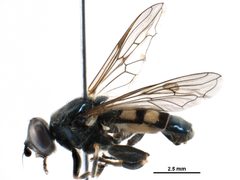
Chalcosyrphus anthreas, commonly known as the yellow-banded leafwalker, is a rare of syrphid fly found in eastern North America. The species belongs to the Syrphidae (hoverflies or flower flies), a group known for their ability to remain nearly motionless in . are typically found on flowers, where they obtain nectar and pollen. The species was originally described by Walker in 1849 under the basionym Xylota anthreas.
Pronunciation
How to pronounce Chalcosyrphus anthreas: /kælkoʊˈsɜrfəs ˈænθriəs/
These audio files are automatically generated. While they are not always 100% accurate, they are a good starting point.
Identification
The can be distinguished from similar Chalcosyrphus species by its all-black coloration without steel blue highlights (seen in C. chalybeus) or red abdominal markings (seen in C. piger). Males possess (contiguous) . The species exhibits enlarged and ventrally spinose metafemora with correspondingly curved tibiae. The "yellow-banded leafwalker" suggests distinctive yellow banding, though specific pattern details require further verification.
Images
Habitat
Associated with forested environments, particularly areas with dead and decaying wood. have been observed on the trunks of recently wind-thrown trees, suggesting an intimate association with dead wood .
Distribution
Eastern North America. Recorded from Canada and the United States.
Diet
feed on nectar and pollen from flowers. Larvae are saprophages that develop in decaying wood, feeding on decomposing plant matter rather than acting as .
Life Cycle
Complete with , larval, pupal, and stages. Larvae develop in decaying wood, where they function as saprophages. Specific details on egg-laying and sites are not well documented.
Behavior
are known to hover in and repeatedly return to and land on dead tree trunks when disturbed. This suggests a strong association with dead wood , likely related to larval development requirements.
Ecological Role
serve as while foraging on flowers for nectar and pollen. Larvae contribute to wood decomposition processes as saprophages in decaying wood .
Human Relevance
As a rare , it may serve as an indicator of healthy forest with adequate dead wood . No direct economic or agricultural significance is documented.
Similar Taxa
- Chalcosyrphus chalybeusSimilar all-black coloration, but C. chalybeus exhibits distinctive steel blue highlights absent in C. anthreas
- Chalcosyrphus pigerSimilar overall , but C. piger consistently shows red abdominal markings which C. anthreas lacks
- Xylota speciesRelated with similar dead wood associations; C. anthreas was originally described under Xylota and shares morphological similarities with this genus