
Temnostoma balyras
(Walker, 1849)
Yellow-haired Falsehorn
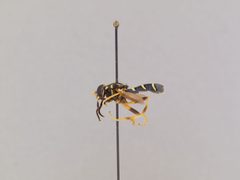
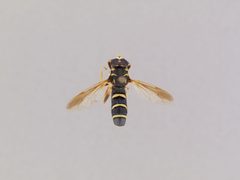
Temnostoma balyras, commonly known as the Yellow-haired Falsehorn, is a syrphid fly found in eastern North America. are flower visitors that feed on nectar and pollen. The species exhibits elaborate mimicry of solitary mason wasps, including darkened wing margins and behavioral adaptations. Larvae develop in moist decayed wood, where they use thoracic hooks as rasping organs to burrow.
Pronunciation
How to pronounce Temnostoma balyras: /tɛmˈnɔstoʊmə ˈbælɪræs/
These audio files are automatically generated. While they are not always 100% accurate, they are a good starting point.
Identification
in the Temnostoma are distinguished from other syrphid flies by darkened leading wing margins, which mimic the longitudinal wing folds of vespid at rest. When at rest, individuals wave their front legs in front of the to simulate wasp . The specific epithet "balyras" and "Yellow-haired Falsehorn" suggest yellow pilosity on the or , though detailed -level diagnostic features require examination of specimens.
Images
Habitat
frequent woodland edges and flower-rich areas. Larvae inhabit moist decayed wood, including rotting logs and stumps.
Distribution
Eastern half of the United States and adjacent areas of Canada. Specific records include Vermont.
Seasonality
have been observed in mid-May in Illinois, suggesting spring activity; full seasonal range undocumented.
Diet
feed on nectar and pollen from flowers. Larval diet in decayed wood is not explicitly documented for this .
Life Cycle
Larval stage occurs in moist decayed wood, where individuals burrow using paired thoracic hooks operated by enlarged mesothoracic and metathoracic muscles. Larvae have been formally described by Heiss in a 1938 classification of Illinois Syrphidae larvae.
Behavior
exhibit -mimicking : waving forelegs to simulate , and possessing darkened wing margins that resemble folded wasp wings. includes hovering capability typical of Syrphidae.
Ecological Role
may contribute to pollination through flower visitation. Larvae contribute to wood decomposition processes in forest .
Human Relevance
No documented economic or medical significance. Like other hoverflies, are harmless to humans despite -like appearance.
Similar Taxa
- Temnostoma spp.Other in share -mimicking wing darkening and leg-waving ; species-level identification requires detailed examination.
- Sphecomyia vittataAnother syrphid mimic with similar size and yellowjacket-like appearance, but distinguished by longer, thicker and different pattern.
- Chalcosyrphus spp.Related syrphid with larvae in decaying wood, but typically flick wings like rather than waving legs; often have different coloration.
More Details
Mimicry
Temnostoma balyras represents an extreme example of , converging on solitary mason wasps (Eumeninae) in both and . The leg-waving behavior specifically compensates for the dipteran lack of long .
Larval Morphology
Larval description by Heiss (1938) in 'A classification of the larvae and of the Syrphidae of Illinois exclusive of aquatic forms' provides formal documentation of stages.