
Blera robusta
(Curran, 1922)
Greenish Wood Fly
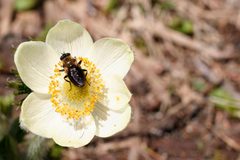
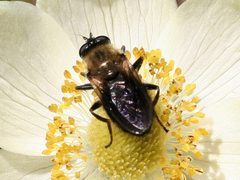
A rare Nearctic syrphid fly first described by Curran in 1922. are known as flower flies, feeding on nectar and pollen. Larvae are rat-tailed type, developing in exuding sap or rot holes of trees. The is considered uncommon throughout its range.
Pronunciation
How to pronounce Blera robusta: /ˈblɛrə roʊˈbʌstə/
These audio files are automatically generated. While they are not always 100% accurate, they are a good starting point.
Identification
Distinguished from other Blera by the combination of: shining blue-black with long pale yellow pile; with yellow below and at sides; wings with yellow bases and moderately brownish coloration; black legs with yellow femoral tips and yellow tibial bases/ends. The sub-keel-shaped face with produced is a key facial character.
Images
Habitat
Associated with woodland environments where larval development occurs in exuding sap or rot holes of trees. activity centered on flowering vegetation.
Distribution
Nearctic region: Northwestern United States and Southwestern Canada.
Diet
feed on nectar and pollen from flowers. Larvae feed on exuding sap or in rot holes of trees.
Life Cycle
Larvae are rat-tailed type, developing in exuding sap or rot holes of trees. Complete with , larval, pupal, and stages. Specific timing of life stages not documented.
Behavior
hover motionless in . Commonly found on flowers.
Ecological Role
contribute to pollination through flower visitation. Larvae function as saprophages in tree sap and rot hole microhabitats.
Human Relevance
No documented direct human interactions. Conservation interest due to rarity.
Similar Taxa
- Other Blera speciesShare rat-tailed larvae and wood-associated ; distinguished by specific color patterns, facial , and wing markings
- Other syrphid flies with rat-tailed larvae (e.g., Eristalis)Share larval in decaying organic matter and tree sap; distinguished by coloration, size, and facial structure
More Details
Taxonomic history
First officially described by Curran in 1922. The specific epithet 'robusta' refers to the robust build of the .
Conservation status
Described as rare in sources; limited observation records (5 observations in iNaturalist as of source date).
Sources and further reading
- BugGuide
- Wikipedia
- GBIF taxonomy match
- iNaturalist taxon
- Catalogue of Life
- Grasshoppers of Colorado
- Grasshoppers of Colorado
- Grasshoppers of Colorado
- And then there were 10 – unexpected diversity in New Zealand kanuka genus Kunzea | Blog
- Conservation Translocations: It’s Not Just Beavers - Buglife Blog - Buglife