
Blera confusa
Johnson, 1913
Confusing Wood Fly
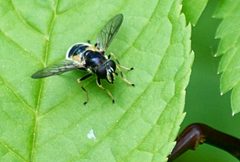
Blera confusa, commonly known as the Confusing Wood Fly, is a syrphid fly first described by Johnson in 1913. are flower visitors that feed on nectar and pollen. The larvae are of the rat-tailed type, developing in exuding sap or rot holes of trees. The species is widely distributed across eastern and central North America.
Pronunciation
How to pronounce Blera confusa: //ˈblɛ.ra kənˈfu.sa//
These audio files are automatically generated. While they are not always 100% accurate, they are a good starting point.
Identification
Distinguished from similar syrphid flies by the combination of: yellow with distinct black facial stripe beneath antennal process; greenish black shining with yellowish pile; abdominal pattern with large yellow triangles on second segment that are continuous with smaller triangles on third segment; and yellow . The female's reduced yellow markings on the third abdominal segment provide additional diagnostic characters.
Images
Habitat
Associated with woodland environments where larval development occurs in exuding sap or rot holes of trees. frequent flowers in and near wooded areas.
Distribution
Nearctic widely distributed in eastern and central North America. Documented from Vermont and other eastern and central US states.
Diet
feed on nectar and pollen from flowers. Larvae feed on exuding sap or in rot holes of trees.
Life Cycle
Larvae are of the rat-tailed type, a characteristic form in the Eristalinae where the respiratory siphon is elongated. Larval development occurs in exuding sap or in rot holes of trees. Specific details of and timing are not documented.
Behavior
are commonly observed around and on flowers, where they obtain energy-giving nectar and protein-rich pollen. Like other hoverflies, adults are capable of remaining nearly motionless while in .
Ecological Role
contribute to pollination through flower visitation. Larvae participate in decomposition processes in their sap and rot hole .
Human Relevance
No documented direct interactions with humans. Like other syrphid flies, may be mistaken for bees or due to their coloration and , but they are harmless and do not sting.
Similar Taxa
- Blera fallaxSimilar and general appearance; B. fallax is a European subject to conservation efforts in Scotland, whereas B. confusa is North American
- Other Blera speciesShare -level characteristics including rat-tailed larvae and general body plan; specific abdominal pattern and facial markings distinguish B. confusa
Sources and further reading
- BugGuide
- Wikipedia
- GBIF taxonomy match
- iNaturalist taxon
- NCBI Taxonomy
- Catalogue of Life
- UC Davis-Based Projects: To Bee or Not to Bee? | Bug Squad
- Conservation Translocations: It’s Not Just Beavers - Buglife Blog - Buglife
- ZooKeys with 5 of the Top 10 Marine Species | Blog
- Interview: description of two African shovel-snout snakes from Angola
- Year of the Snake: a serpent selection to celebrate Lunar New Year!