
Blera badia
(Walker, 1849)
Common Wood Fly
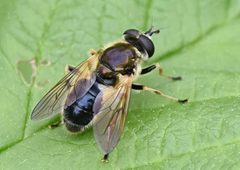
Blera badia, commonly known as the Common Wood Fly, is a Nearctic syrphid fly first described by Walker in 1849. are flower-visiting hoverflies that obtain nectar and pollen from flowers. The species possesses rat-tailed larvae that develop in exuding tree sap or rot holes. It is widely distributed across eastern and central North America.
Pronunciation
How to pronounce Blera badia: /ˈblɛ.ra ˈbæ.di.a/
These audio files are automatically generated. While they are not always 100% accurate, they are a good starting point.
Identification
Distinguished from similar syrphid flies by the combination of: greenish-black shining and ; yellow triangular abdominal markings on second segment extending onto third segment (sexually dimorphic in width); yellowish-white with silvery dusting and medial black vitta; and characteristic leg pattern with black having yellow tips and yellow tibiae with dark rings. The wing venation with straight R4+5 and acute first provides additional diagnostic characters. Similar Blera may differ in abdominal marking patterns and extent of yellow coloration.
Images
Habitat
Associated with woodland environments where larval development occurs in exuding tree sap and rot holes of trees. frequent flowering vegetation in and near wooded areas.
Distribution
Nearctic widely distributed in eastern and central North America. Documented from Vermont and other eastern US states.
Diet
feed on nectar and pollen from flowers. Larvae feed on exuding sap or in rot holes of trees.
Life Cycle
Larvae are of the rat-tailed type, adapted for living in exuding tree sap or decaying wood in tree rot holes. Specific details of and timing are not documented.
Behavior
exhibit hovering typical of syrphid flies. Regularly visits flowers for feeding. Larval stage confined to arboreal microhabitats (sap flows, rot holes).
Ecological Role
contribute to pollination through flower visitation. Larvae participate in nutrient cycling and decomposition processes in decaying wood and sap flows.
Similar Taxa
- Blera fallaxCongeneric syrphid fly with similar woodland associations; differs in specific abdominal marking patterns and distribution (Pine Hoverfly subject to UK conservation efforts)