
Eristalis brousii
Williston, 1882
Hourglass Drone Fly
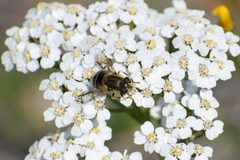
Eristalis brousii, commonly known as the hourglass drone fly, is a hoverfly first described by Samuel Wendell Williston in 1882. The species has experienced severe decline across North America following the introduction of the European Eristalis arbustorum near Toronto around 1885. As of 2019, it persists only along the lake margin of Hudson Bay in Northern Canada, making it one of the most geographically restricted hoverflies on the continent. Like other Eristalis species, are while larvae develop as aquatic filter-feeders.
Pronunciation
How to pronounce Eristalis brousii: //ɛˈrɪstəlɪs ˈbruːsi.aɪ//
These audio files are automatically generated. While they are not always 100% accurate, they are a good starting point.
Identification
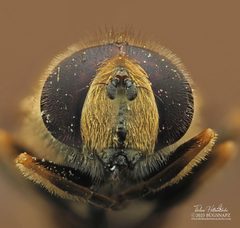
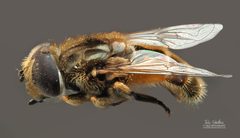
measure 9–12 mm in length. Distinguished from the similar Eristalis arbustorum by leg coloration: E. brousii has yellow on the basal half of the mesotibia and reddish-brown to black on the basal tarsomere of the mesoleg, whereas E. arbustorum has yellow restricted to the basal third of the mesotibia with brown and black on the basal tarsomere. Males have contiguous for only a short distance. The frontal triangle is slightly shiny along the middle. are black with the third joint () red. The is red and briefly pilose near the base. The is black with luster, bearing two opaque lightly colored stripes reaching from front to scutellum, limited by three narrow opaque black stripes. Scutellum is subtranslucent yellow or red on the outer part. Wings are hyaline with brown stigma; females have a large brown wing spot. Male : first segment black, second orange or yellow with broad sides and narrow hind border, third with large yellow spots confluent anteriorly, fourth wholly shining with yellow hind margin. Female abdomen mostly black with small opaque spots possible on second through fourth segments, and broad white pollinose bands on hind borders of segments two through four.
Images
Habitat
Larval is aquatic; larvae are rat-tailed filter-feeders in water. foraging habitat includes flowers. Specific habitat requirements for the remaining Hudson Bay are poorly documented.
Distribution
to North America. Historically distributed more broadly across the continent. Currently restricted to the lake margin of Hudson Bay in Northern Canada as of 2019. The has become largely extinct throughout its former range south of this region.
Diet
Larvae are aquatic filter-feeders. collect nectar and pollen from flowers.
Life Cycle
Complete . Larvae are rat-tailed maggots—aquatic filter-feeders with elongated siphons for respiration. Specific details of and are not documented for this .
Behavior
hover above flowers to collect nectar and pollen, characteristic of the hoverfly .
Ecological Role
function as . Larvae contribute to nutrient cycling as aquatic filter-feeders in freshwater systems.
Similar Taxa
- Eristalis arbustorumVery similar in overall appearance and size, distinguished reliably by mesotibia coloration pattern: E. brousii has yellow on basal half of mesotibia versus basal third in E. arbustorum, and by basal tarsomere coloration of the mesoleg.
Sources and further reading
- BugGuide
- Wikipedia
- GBIF taxonomy match
- iNaturalist taxon
- NCBI Taxonomy
- Catalogue of Life
- To Bee or Not to Bee | Bug Squad
- A friendlier type of drone: Common Drone Fly, Eristalis tenax — Bug of the Week
- Bug Eric: Fly Day Friday: Rat-tailed Maggots
- Insect Migration (Part 1) - Buglife Blog - Buglife
- Mudo Pryfed (Rhan 1) - Buglife Blog - Buglife
- Strathmore B-Lines: Surveying Grasslands and Pollinating Insects in the Strathmore Valley - Buglife Blog - Buglife