
Sphiximorpha willistoni
(Kahl, 1897)
Williston's Wasp Fly
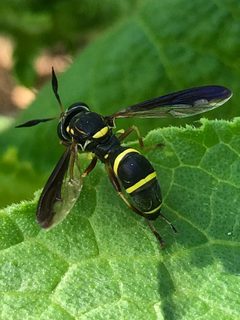
Sphiximorpha willistoni is a rare syrphid fly to eastern North America. are conspicuous mimics, displaying black and yellow coloration, darkened forewings, and an elongate, constricted waist. The exhibits strong in markings and separation. Adults frequent flowers for nectar and pollen. Larvae develop in tree sap runs, a trait characteristic of the .
Pronunciation
How to pronounce Sphiximorpha willistoni: //sfɪksɪˈmɔrfə wɪˈlɪstəni//
These audio files are automatically generated. While they are not always 100% accurate, they are a good starting point.
Identification
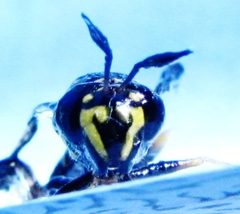
are readily distinguished from other eastern North American syrphid flies by the combination of: dark brown to black half of wings with hyaline half; extremely long, slender with sharply pointed ; and a distinctly constricted, -waisted with raised yellow bands. is pronounced: males have contiguous at the vertex and typically display a yellow V-shaped stripe on the above the antennae; females have widely separated eyes and usually bear four small yellow spots in the corresponding position. The is long and flat, black with a central yellow field containing a large black arrowhead-shaped spot. The has complex yellow markings including an oblique spot on the presutural callus and longitudinal stripes on the . Body length 11–14 mm.
Images
Habitat
occur in wooded and forest-edge where flowering vegetation is present. Larval habitat consists of sap runs on living or recently injured hardwood trees.
Distribution
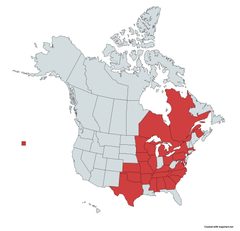
Eastern North America. Specific range details are poorly documented beyond this general region; the is considered rare throughout its range.
Diet
feed on nectar and pollen from flowers. Larval diet is presumed to consist of microorganisms and organic matter in tree sap runs, though this has not been directly documented for this .
Life Cycle
Complete with , larva, pupa, and stages. Larvae develop in sap runs of trees. Specific details of oviposition , larval development duration, and site are unknown.
Behavior
are capable of sustained hovering and can remain nearly motionless in the air, typical of syrphid flies. The is a strong mimic in both appearance and presumably , though specific mimetic behaviors such as leg-waving or -curling have not been documented. Adults are and actively visit flowers.
Ecological Role
contribute to pollination through flower visitation. Larvae in tree sap runs likely participate in nutrient cycling and microbial dynamics within this specialized microhabitat. The serves as a model for of vespid .
Human Relevance
The has no known economic importance. Its rarity and striking -mimetic appearance make it of interest to entomologists and naturalists.
Similar Taxa
- Sphiximorpha other speciesOther members of the share the -mimetic body form and sap-run larval , but differ in specific and thoracic markings, wing darkening patterns, and geographic distribution. S. willistoni is the primary eastern North American representative.
- Spilomyia longicornisAnother eastern North American syrphid mimic with long and darkened wings, but Spilomyia has shorter, less slender antennae, different abdominal patterning, and lacks the sharply constricted waist of Sphiximorpha.
- Temnostoma spp.-mimetic syrphids with yellow and black thoracic markings, but Temnostoma have shorter , different wing venation, and lack the pronounced wing darkening and extreme waist constriction of S. willistoni.