
Cerioidini
Wahlgren, 1909
Genus Guides
4Cerioidini is a tribe of hoverflies (Syrphidae) comprising approximately 197–222 . Members are conspicuous mimics, with elongated bearing a terminal and often constricted . Larvae develop in tree sap associated with wounds or in putrefying water within tree cavities.
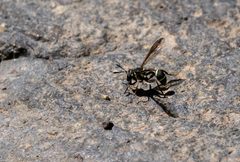
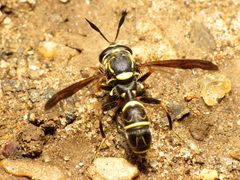
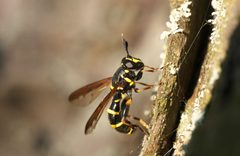
Pronunciation
How to pronounce Cerioidini: /ˌsɪə.riˈɔɪ.dɪˌnaɪ/
These audio files are automatically generated. While they are not always 100% accurate, they are a good starting point.
Identification
Distinguished from other hoverfly tribes by the combination of: (1) terminal on elongated , (2) elongate and basally constricted , (3) characteristic wing venation with cross- r-m at or beyond the middle of the , open r1 and r2+3, closed cell r4+5 near the wing margin, and (4) -mimetic coloration with dark and clear wing halves. separable by relative proportions of antennal segments and degree of abdominal constriction.
Images
Appearance
exhibit pronounced mimicry in coloration and structure. are long and slender with a terminal ; the is consistently elongate, while scape and proportions vary among . The is elongated, sometimes with color patterns suggesting wasp . The is elongate and often constricted at the first and/or second segments—slightly in Ceriana, pronounced in Sphiximorpha and Polybiomyia, and extremely so in Monoceromyia. Wing pattern typically shows dark coloration and clear half, creating the illusion of dark forewings and clear hindwings. A frontal prominence may add to antennal elongation but is reduced in some genera.
Habitat
occur in wooded and forested environments where larval are present. Larval is specialized: tree sap flows associated with wounds, and putrefying water pockets in tree cavities.
Distribution
Widespread; West-Palaearctic region documented with particular detail including Cyprus, Afghanistan, Iran, Armenia, and Azerbaijan. Global distribution encompasses multiple biogeographic regions.
Life Cycle
Larvae develop in tree sap or putrefying water within tree cavities. Specific details of deposition, , and are not documented in available sources.
Behavior
When captured, perform abdominal movements mimicking a sting. Adults lack functional and stingers; the stinging motion is deceptive.
Similar Taxa
- Other Syrphidae tribesNon-cerioidine hoverflies lack the terminal , have different antennal proportions, and typically show less pronounced abdominal constriction and -mimetic wing patterning.
- Vespidae (wasps)Cerioidini are frequently mistaken for due to convergent coloration, elongated , and behavioral mimicry; distinguished by single pair of wings (Diptera), lack of functional stinger, and absence of wasp-like petiole structure.
More Details
Taxonomic Note
count varies between sources: Wikipedia cites ~222 species, iNaturalist ~197. The tribe includes Ceriana, Primocerioides, Sphiximorpha, Polybiomyia, and Monoceromyia, with antennal segment ratios and abdominal constriction degree serving as key diagnostic characters.