
Ceriana ancoralis
(Coquillett, 1902)
Black-sided Wasp Fly
Ceriana ancoralis is a of syrphid fly commonly known as the Black-sided Fly. It is a wasp mimic, displaying coloration and body form that resembles vespid wasps such as yellowjackets and paper wasps. This mimicry provides protection from that avoid wasps. The species has been documented in limited observations, with 21 records on iNaturalist.
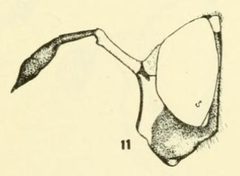
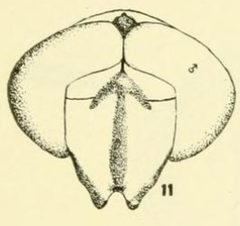
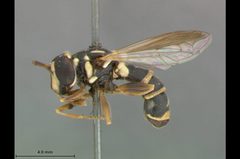
Pronunciation
How to pronounce Ceriana ancoralis: /sɛˈriː.ə.nə æŋkəˈræ.lɪs/
These audio files are automatically generated. While they are not always 100% accurate, they are a good starting point.
Identification
Distinguished from true (Vespula, Polistes) by having only two wings instead of four, presence of (knoblike bristles) on , and spongelike mouthparts. From other syrphid flies by its specific wasp-mimic coloration and body form characteristic of the Ceriana. The specific epithet 'ancoralis' may refer to anchor-like markings, though this requires verification.
Images
Habitat
Associated with flowering plants where forage for nectar. Larval involves tree fissures where are deposited.
Distribution
Documented in North America, specifically recorded in California (Napa County at Spanish Flat on Lake Berryessa). Distribution details remain limited due to sparse observation records.
Seasonality
active during warmer months when flowering plants are available. Specific seasonal patterns not well documented.
Diet
feed on nectar from flowers. Larvae feed on sap from trees after hatching, based on observation of Ceriana tridens.
Life Cycle
Females oviposit in fissures of trees. Larvae hatch and feed on tree sap. Complete with , larval, pupal, and stages, typical of Diptera.
Behavior
hover helicopter-like over flowers before landing to forage, a common to syrphid flies. pattern mimics movement, enhancing protective mimicry.
Ecological Role
function as while foraging on flowers. Larvae contribute to nutrient cycling in tree microhabitats.
Human Relevance
Subject of nature photography due to striking -mimic appearance. Documented in international Insect Salon photography competition through Ceriana tridens. May cause alarm to observers mistaking it for a stinging wasp.
Similar Taxa
- Ceriana tridens with similar -mimic appearance and ; both oviposit in tree fissures and have larvae that feed on tree sap.
- Vespula pensylvanica (Western yellowjacket)True that Ceriana ancoralis mimics in coloration and body form; distinguished by four wings, lack of , and stinging capability.
- Polistes dominula (European paper wasp)Another mimicked by Ceriana; distinguished by four wings, different structure, and paper nest construction.
Misconceptions
Frequently mistaken for a stinging due to protective mimicry. Picnickers and casual observers may attempt to swat or flee from it unnecessarily. It is harmless and lacks a stinger.
More Details
Taxonomic note
The name 'ancoralis' was authored by Coquillett in 1902. The Ceriana belongs to the tribe Cerioidini within Eristalinae.
Observation status
Only 21 observations recorded on iNaturalist as of source date, indicating it is either genuinely rare, underreported, or difficult to distinguish from similar in the field.