
Stratiomys normula
(Loew, 1866)
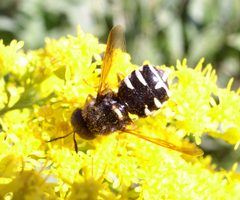
Stratiomys normula is a of soldier fly in the Stratiomyidae, first described by Loew in 1866. It is one of several North American species in the Stratiomys that exhibit -mimicking coloration. The species has been recorded from Canada and the United States. Like other members of its genus, it is and associated with wetland where its larvae develop.
Pronunciation
How to pronounce Stratiomys normula: /ˌstræt.iˈɒmɪs nɔrˈmjuːlə/
These audio files are automatically generated. While they are not always 100% accurate, they are a good starting point.
Identification
Members of the Stratiomys are recognized by their robust, -like body form with black and yellow or orange banding on the . Stratiomys normula can be distinguished from by specific details of thoracic and abdominal patterning, though precise diagnostic features require examination of . The are typically large and may show in coloration. lack the narrow petiole (wasp waist) of true vespid wasps, having instead a broader connection between and abdomen characteristic of Diptera.
Images
Habitat
Wetland and riparian environments; larvae are aquatic or semi-aquatic, developing in shallow water or saturated soils. are often found in vegetation near larval .
Distribution
Canada, United States.
Life Cycle
Aquatic or semi-aquatic larvae; are terrestrial. Specific developmental details for this are not documented.
Behavior
activity pattern. are flower visitors. Members of the Stratiomys are generally not flighty and can be approachable, though this varies by and individual.
Ecological Role
Larvae contribute to nutrient cycling in aquatic and semi-aquatic . may serve as during flower visitation. -mimicking appearance likely provides protection from ().
Similar Taxa
- Hoplitimyia mutabilisSimilar -mimicking soldier fly with black and yellow coloration; distinguished by -level differences in wing venation and body proportions, and by geographic distribution (Hoplitimyia mutabilis occurs in South America).
- Vespid wasps (Hymenoptera: Vespidae)Convergent black and yellow warning coloration; distinguished by presence of two pairs of wings (vs. one pair plus in flies), narrow petiole between and , and elbowed .
- Syrphid flies (Syrphidae)Similar -mimicking hoverflies with comparable color patterns; distinguished by wing venation with spurious , and typically more slender body form with different proportions.