
Hoplitimyia
James, 1934
Species Guides
3Hoplitimyia is a of soldier flies ( Stratiomyidae) established by James in 1934. The genus comprises approximately ten described distributed across the Americas, with records from both North and South America. Species within this genus exhibit the characteristic features of the Stratiomyinae, including patterned and -mimicking coloration. Larvae are aquatic, a trait common to the subfamily.
Pronunciation
How to pronounce Hoplitimyia: //hɒplɪˈtɪmi.jə//
These audio files are automatically generated. While they are not always 100% accurate, they are a good starting point.
Identification
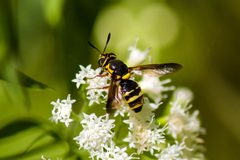
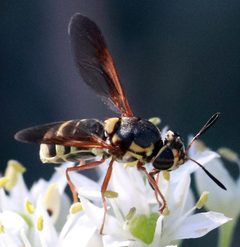
of Hoplitimyia can be recognized by their soldier fly combined with distinctive black and yellow -mimicking coloration. The is characterized by large, prominently patterned with horizontal banding—a feature shared with many stratiomyine flies and potentially associated with detection of horizontally polarized light. The body form is relatively robust compared to some other stratiomyid genera. -level identification is challenging; expert Norman Woodley has noted that "the species are a mess," with poorly resolved particularly in South America. Separation from similar genera such as Odontomyia requires examination of subtle morphological characters.
Images
Habitat
have been observed in association with flowering vegetation, including on the flowers of woody vines. Based on the aquatic larval characteristic of the Stratiomyinae, suitable includes areas adjacent to aquatic or semi-aquatic environments where larvae develop.
Distribution
The occurs in the Americas, with recorded from the United States, Mexico, Central America, and South America (including Argentina and Panama). Specific distribution records include Buenos Aires Province in Argentina for H. mutabilis and vicinity of the type localities for other described species.
Diet
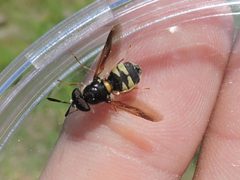
have been observed feeding on sugar solutions in captivity, suggesting nectar or honeydew feeding in nature. Larvae are aquatic; while specific feeding habits for Hoplitimyia larvae are not documented, stratiomyine larvae are generally known to be saprophagous or in aquatic environments.
Life Cycle
Larvae are aquatic, developing in water or saturated substrates. emerge and have been observed to be highly active and flighty, with rapid escape responses when disturbed. Specific details of , -laying , and larval development stages are not documented.
Behavior
are extremely flighty and difficult to approach for observation or photography. When confined, they exhibit persistent escape , immediately attempting when released. They have been observed to briefly pause for feeding when provided with sugar solution, allowing short periods of close observation before resuming flight attempts. The prominent banding suggests visual acuity potentially used for locating mates and oviposition sites near water.
Ecological Role
As aquatic larvae, they likely contribute to nutrient cycling and dynamics in freshwater systems. may serve as when visiting flowers for nectar. Their -mimicking appearance suggests a defensive mimicry function, potentially reducing pressure.
Similar Taxa
- OdontomyiaSimilar overall appearance and shared tribe Stratiomyini; Hoplitimyia distinguished by specific patterns and body proportions, though precise separation requires expert examination
- HedriodiscusRelated in tribe Stratiomyini with which Hoplitimyia shares general body plan and -mimetic coloration; separation based on subtle morphological characters that may be ambiguous in some regions
More Details
Taxonomic Uncertainty
The of Hoplitimyia is poorly resolved, particularly in South America. Expert dipterist Norman Woodley described the species as "a mess," with at least two species in the United States and additional undescribed or poorly characterized species in South America.
Eye Pattern Function
The horizontal banding pattern on the of Hoplitimyia and other stratiomyines may function in detection of horizontally polarized light, similar to tabanid flies. This capability is hypothesized to assist in locating water surfaces for oviposition and finding mates.