
Elgiva solicita
(Harris, 1780)
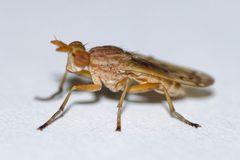
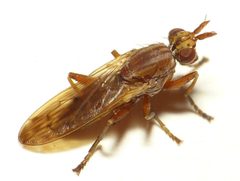
Elgiva solicita is a of marsh fly in the Sciomyzidae, distributed across the Palearctic region from Western Europe to Eastern Asia. are medium-sized flies, 6.5–8 mm in length, with distinctive reddish coloration and characteristic markings on the and . The species is known from a broad geographic range including most of Europe, North Africa, and extending into Russia and the Eastern Palearctic.
Pronunciation
How to pronounce Elgiva solicita: /ˈɛl.dʒɪ.və soʊˈlɪ.sɪtə/
These audio files are automatically generated. While they are not always 100% accurate, they are a good starting point.
Identification
Distinguished from related marsh flies by combination of reddish with specific spot pattern, with grey longitudinal bands, and strong setae on lower surface of front . The absence of an erect macrochaete on the mesopleura separates it from some . The yellowish-white and yellow provide additional diagnostic characters. Size range of 6.5–8 mm is relatively consistent within the .
Images
Appearance
Medium-sized fly, 6.5–8 mm in length. reddish with frontal band bearing two small brown spots at insertion of orbital bristles and larger spot on genae near base; yellowish-white. Antennae , burnished or blackened at apex, with third article slightly longer than second; whitish at apex. brown, palps yellow. rufous with two grey longitudinal bands; pleurae with pale pruinosity; mesopleura ciliated or not, lacking erect macrochaete. Legs yellow with darker ; lower surfaces of front with strong anteroventral and posteroventral setae. Wings vitreous or somewhat yellowish; yellow. rufous with median brown line more or less enlarged.
Distribution
Palearctic region. Documented from Spain, Ireland, Great Britain, France, Belgium, the Netherlands, Norway, Sweden, Finland, Denmark, Germany, Switzerland, Austria, Italy, Poland, Czech Republic, Slovakia, Hungary, Estonia, Latvia, Lithuania, Russia, Ukraine, Romania, Bosnia and Herzegovina, Greece, North Africa, and the Eastern Palearctic.
More Details
Taxonomic Note
Originally described by Harris in 1780. The belongs to tribe Tetanocerini within Sciomyzinae.
Observation Data
98 observations recorded on iNaturalist as of data compilation, indicating moderate detection frequency across its range.