
Sciomyzini
snail-killing flies
Genus Guides
7- Atrichomelina(snail-killing flies)
- Colobaea(snail-killing flies)
- Ditaeniella
- Oidematops
- Pherbellia(snail-killing flies)
- Pteromicra(snail-killing flies)
- Sciomyza(snail-killing flies)
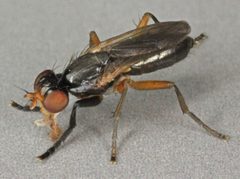
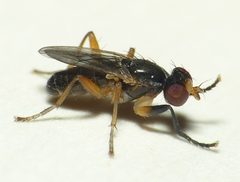
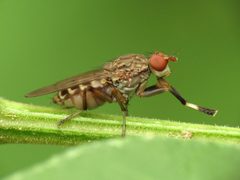
Sciomyzini is a tribe of snail-killing flies within the Sciomyzidae. Larvae are specialized and of freshwater nonoperculate pulmonate snails. The tribe exhibits variable degrees of specialization: some are highly specialized parasitoids with laid directly on snail shells and modified to fit tightly within shells, while others are less specialized with eggs laid on vegetation and larvae acting as parasitoid-predator-saprophages. The tribe includes at least 13 and has been documented in both Palearctic and Nearctic regions.
Pronunciation
How to pronounce Sciomyzini: /ˌsiːoʊmaɪˈzaɪnaɪ/
These audio files are automatically generated. While they are not always 100% accurate, they are a good starting point.
Identification
Members of Sciomyzini can be distinguished from other Sciomyzidae tribes by larval : all known larvae are snail-killers. diagnostic features include characteristics summarized in tribe-level overviews of stage , though specific adult identification requires -level keys. The tribe includes the genus Colobaea, which contains 15 valid distinguishable by adult morphology.
Images
Habitat
Temporary, intermittent, or vernal semiterrestrial situations; aquatic environments with exposed freshwater snails. Highly specialized occupy ephemeral wet where snails occur.
Distribution
Palearctic and Nearctic regions. Documented from Europe, Asia, and North America based on occurrence records for constituent .
Diet
Freshwater nonoperculate pulmonate snails. Larvae kill and consume snails, with some feeding within a single host individual throughout development.
Host Associations
- Galba truncatula - deposition site and larval for Colobaea bifasciella
- Stagnicola palustris - deposition site and larval for Colobaea bifasciella
- Gyraulus parvus - natural for Colobaea americana
- Physa - natural for Colobaea americana
- Anisus vortex - natural for Colobaea pectoralis
- Bathyomphalus contortus - natural for Colobaea pectoralis
- Gyraulus albus - natural for Colobaea punctata
- Lymnaea peregra - natural for Colobaea punctata
- Planorbarius corneus - natural for Colobaea punctata
- Planorbis planorbis - natural for Colobaea punctata
- Gyraulus intermixtus - laboratory for Colobaea deemingi
- Radix gedrosiana - laboratory for Colobaea deemingi
- Anisus spirorbis - documented from in nature for Colobaea distincta
Life Cycle
laid either on snail shells (highly specialized ) or on vegetation (less specialized species). Larva feeds within snail, which is not killed until shortly before larval development completes. occurs within the host snail shell; are strongly modified to fit tightly within host shells in specialized species, less so in species.
Behavior
Highly specialized exhibit precise location and placement on snail shells. Larvae form calcareous septa within snail shells during development. Some species demonstrate facultative saprophagy in addition to .
Ecological Role
and regulating freshwater snail . Potential agents for pest snail .
Human Relevance
Investigated for of snail , including intermediate of trematode affecting humans and livestock.
Similar Taxa
- TetanoceriniOther major tribe of Sciomyzidae; distinguished by larval and morphological features of stages
More Details
Genera included
Apteromicra, Atrichomelina, Calliscia, Colobaea, Ditaeniella, Neuzina, Oidematops, Parectinocera, Pherbellia, Pseudomelina, Psacadina, Pteromicra, Sciomyza, Tetanura
Research focus
Most detailed biological information derives from studies of Colobaea ; broader tribe-level generalizations should be treated cautiously pending additional -specific studies