
Myopa vesiculosa
Say, 1823
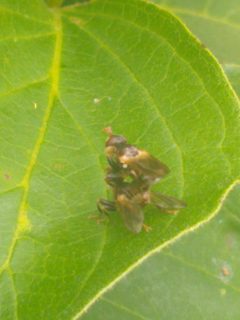
Myopa vesiculosa is a of thick-headed fly in the Conopidae, first described by Thomas Say in 1823. The Myopa comprises internal of bees and , with females intercepting in to oviposit between abdominal segments. Species within Myopa are generally poorly recorded, partly due to identification difficulties.
Pronunciation
How to pronounce Myopa vesiculosa: //ˈmaɪ.oʊ.pə vɛˌsɪk.jəˈloʊ.sə//
These audio files are automatically generated. While they are not always 100% accurate, they are a good starting point.
Identification
Images
Distribution
Recorded from Vermont and other locations in the United States.
Life Cycle
Behavior
Females actively pursue in to oviposit; this interception has led to the 'beegrabbers' for the .
Ecological Role
Internal of bees and (Hymenoptera).
Similar Taxa
- Myopa tessellatipennisBoth are members of Myopa with similar and stout Conopid ; distinguished by wing pattern and other structural features.
- Sicus ferrugineusBoth are Conopidae and internal of Hymenoptera, but Sicus has a more elongated body form and different associations.
- Conops quadrifasciatusBoth are Conopidae with similar lifestyle; Conops often show more distinct abdominal banding and different proportions.