
Myopa rubida
(Bigot, 1887)
Myopa rubida is a of thick-headed fly in the Conopidae, first described by Bigot in 1887. Like all conopids, it is an internal of bees and . The Myopa is seldom recorded, partly due to identification difficulties. Species in this genus are sometimes known as 'beegrabbers' for their habit of intercepting insects in to oviposit between abdominal segments.
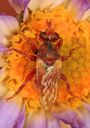
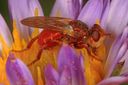
Pronunciation
How to pronounce Myopa rubida: //ˈmaɪ.oʊ.pə ˈruː.bɪ.də//
These audio files are automatically generated. While they are not always 100% accurate, they are a good starting point.
Images
Distribution
The has been documented through iNaturalist observations, though specific geographic range details are not well established in available sources.
Diet
Life Cycle
Conopid flies have a parasitic involving , larval, pupal, and stages. Eggs are deposited directly into the insect. Larvae develop internally, eventually killing the host. typically occurs in the soil after the host dies. Specific details for M. rubida are not documented.
Behavior
Ecological Role
As a of bees and , M. rubida contributes to of its . The ecological impacts are poorly studied due to limited records of this .
Similar Taxa
- Myopa tessellatipennisBoth are members of the Myopa, sharing the characteristic stout build, broad , and curved abdominal posture typical of conopid flies. M. tessellatipennis is more frequently recorded and has been studied in relation to associations.
- Sicus ferrugineusAnother conopid fly that parasitizes bees and . More commonly encountered than Myopa , with similar overall and strategy.
- Conops quadrifasciatusA conopid fly with similar parasitic lifestyle on hymenopterans. More frequently recorded than Myopa in some regions.
More Details
Taxonomic obscurity
The Myopa is notably under-recorded in entomological surveys. This may reflect genuine rarity, but more likely stems from identification difficulties, brief periods, and the secretive habits of these flies.
Host uncertainty
Unlike some better-studied conopids, the specific of M. rubida remains undocumented. Related Myopa species have been tentatively linked to mining bees (Andrena), but no direct observations confirm this for M. rubida.
Sources and further reading
- BugGuide
- Wikipedia
- GBIF taxonomy match
- iNaturalist taxon
- Catalogue of Life
- Meloidae Holdings | Entomology Research Museum
- Northern Ireland, invertebrate finds in review 2023 - Buglife Blog - Buglife
- Bug Eric: Kissing Bugs
- Bug Eric: The Black Corsair
- Risk of Chagas Disease in Texas May Be Higher than Previously Thought