
Physoconops brachyrhynchus
(Macquart, 1844)
thick-headed fly
Physoconops brachyrhynchus is a of thick-headed fly in the Conopidae. Like other members of its , it exhibits mimicry, resembling potter wasps in appearance. The species is a , with females known to attack bees and wasps to deposit . It has been documented in the northeastern United States, including Vermont.
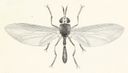
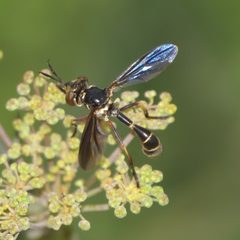
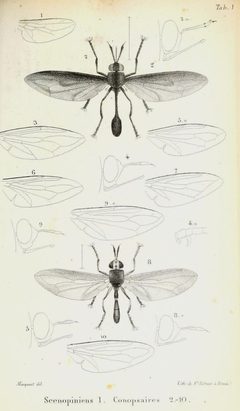
Pronunciation
How to pronounce Physoconops brachyrhynchus: //ˌfaɪsoʊˈkoʊnɒps ˌbrækiˈrɪŋkəs//
These audio files are automatically generated. While they are not always 100% accurate, they are a good starting point.
Identification
Resembles potter wasps (Vespidae: Eumeninae) but can be distinguished by: single pair of wings (Diptera) versus two pairs in (Hymenoptera); present; beak-like ; and wing venation with characteristic darkened costal margin. Distinguished from similar conopid Physocephala by structural features of the and , though precise differentiating characters require expert examination.
Images
Habitat
Found in open with abundant flowers. frequent flowering vegetation where they obtain nectar. Presence tied to availability of bees and .
Distribution
Documented from the northeastern United States. GBIF records indicate occurrence in Vermont, USA. Distribution likely broader but specific range boundaries poorly documented.
Seasonality
active during warmer months when flowering plants and insects are available. Exact period not well documented for this ; related conopids typically show summer activity with possible multiple in southern portions of range.
Diet
feed on nectar from flowers. Larvae are internal , feeding on bees or .
Host Associations
- Bombus - Related conopids in Physocephala attack bumble bees; associations for P. brachyrhynchus specifically not documented but likely similar
- Hymenoptera - Conopidae are known of bees and ; specific for this require confirmation
Life Cycle
Females attack bees or in , forcing them to ground and depositing between abdominal segments. Larva hatches and develops as internal , killing host in approximately 10-12 days. Pupa forms inside hollow host . timing varies; may have multiple annually in warmer climates.
Behavior
are agile fliers. Females exhibit active pursuit to intercept insects mid-air. Adults frequently visit flowers for nectar. Exhibits of stinging , likely reducing risk.
Ecological Role
of bees and , potentially influencing . pollination services through nectar feeding. Contributes to mimicry complexes involving wasp-like appearance.
Human Relevance
No direct economic importance. Occasionally encountered by entomologists and naturalists due to -like appearance causing initial misidentification. Not harmful to humans; cannot parasitize humans.
Similar Taxa
- PhysocephalaSimilar -mimicking conopids with elongated and dark wing margins; distinguished by and antennal structure
- EumeninaePotter wasps which P. brachyrhynchus mimics; true have two wing pairs, different wing venation, and lack the beak-like mouthparts
- ZodionSmaller conopid (5-7 mm versus larger Physocephala/Physoconops) also parasitizes but differs in size and proportions
More Details
Taxonomic note
Authority sometimes cited as Macquart, 1843 or 1844; basionym Conops brachyrhynchus.
Data gaps
Specific records, detailed distribution, and precise morphological for this remain poorly documented in accessible literature.