
Chalarus
Walker, 1834
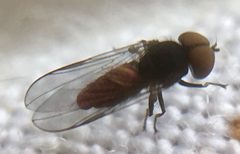
Chalarus is a of big-headed flies in the Pipunculidae, established by Walker in 1834. The genus has distribution with approximately 45 described found across multiple continents. Chalarus species are primary of typhlocybine leafhoppers (Cicadellidae), a relationship that has been documented through and oviposition studies. As members of Pipunculidae, they contribute to of leafhopper in various .
Pronunciation
How to pronounce Chalarus: /ˈkælərəs/
These audio files are automatically generated. While they are not always 100% accurate, they are a good starting point.
Identification
Chalarus can be distinguished from other Pipunculidae by features of the male genitalia, particularly structures of the and surstyli. Species-level identification requires examination of these genitalic characters and is supported by dichotomous keys available for regional faunas, including the Neotropical species. The genus is placed in Chalarinae based on morphological synapomorphies.
Images
Distribution
distribution with records from Europe (Denmark, Norway, Sweden), Asia (China, Thailand), South America (Colombia, Brazil, Chile), and other regions. The Neotropical Region contains 11 known . Specific Colombian localities include Cabaña Chaina in Santuario de Fauna y Flora Iguaque and Vereda Tigrera Alta in Cartagena del Chaira.
Host Associations
- typhlocybine leafhoppers - Primary of Typhlocybinae (: Cicadellidae). Oviposition and larval development have been studied in this association.
Life Cycle
Larval development occurs within typhlocybine leafhopper . Detailed studies have been conducted on Chalarus in comparison with hymenopteran of the same hosts.
Behavior
Females exhibit specialized oviposition targeting typhlocybine leafhoppers. The specific mechanisms of location and attack have been subjects of dedicated behavioral studies.
Ecological Role
As primary of leafhoppers, Chalarus function as natural agents regulating of their typhlocybine in various .
Similar Taxa
- other Pipunculidae generaChalarus is distinguished by male genitalic and placement in Chalarinae; other in Pipunculidae may share general big-headed fly appearance but differ in specific structural characters and associations.
- Aphelopus (Hymenoptera: Dryinidae)Both are primary of typhlocybine leafhoppers and have been studied comparatively; Chalarus is dipteran while Aphelopus is hymenopteran, differing fundamentally in , , and parasitoid strategy.
More Details
Taxonomic History
The was established by Walker in 1834. Numerous have been described subsequently, with significant contributions by Jervis (1992), Rafael (1988-1990), Kehlmaier (2003-2008), and Morakote (1990). Two new species from Colombia (C. boyacensis and C. chairensis) were described in 2023.
Research Significance
Chalarus has served as a model group for comparative studies of , particularly in contrast to hymenopteran parasitoids of the same . These studies have advanced understanding of in parasitoid across insect orders.
Sources and further reading
- BugGuide
- Wikipedia
- GBIF taxonomy match
- iNaturalist taxon
- NCBI Taxonomy
- Catalogue of Life
- Studies on oviposition behaviour and larval development in species ofChalarus(Diptera, Pipunculidae), parasites of typhlocybine leafhoppers (Homoptera, Cicadellidae)
- Chalarus (Diptera: Pipunculidae) of Colombia, with description of two new species and an updated key to males of the Neotropical species
- Life history studies onAphelopusspecies (Hymenoptera, Dryinidae) andChalarusspecies (Diptera, Pipunculidae), primary parasites of typhlocybine leafhoppers (Homoptera, Cicadellidae)