
Pipunculidae
Walker, 1834
Big-headed Flies
Subfamily Guides
3- Chalarinae(big-headed flies)
- Nephrocerinae
- Pipunculinae(big-headed flies)
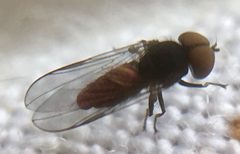
is a of flies (Diptera) commonly known as big-headed flies, distinguished by their large that cover nearly the entire . The family has a worldwide distribution with over 1,400 described . Larvae develop as almost exclusively in Auchenorrhyncha (leafhoppers, planthoppers, and cicadas), with the exception of the Nephrocerus, which parasitizes crane flies (Tipulidae). Molecular analysis indicates the family originated in the Maastrichtian age of the Late Cretaceous, with the oldest fossils dating to the Eocene. Some species are used as agents in rice fields.
Pronunciation
How to pronounce Pipunculidae: /pɪˌpʊŋkjʊˈlɪdiː/
These audio files are automatically generated. While they are not always 100% accurate, they are a good starting point.
Identification
The combination of (meeting dorsally) that dominate the , short , and compact humpbacked body distinguishes from most other Diptera . They may be confused with Conopidae (thick-headed flies), which also have large heads, but Conopidae typically have a more elongated and different wing venation. Male Pipunculidae are readily identified by the holoptic eyes; females have dichoptic eyes with a distinct . Accurate identification to or level requires examination of male genitalia and other fine morphological details.
Images
Habitat
are found in diverse terrestrial including forests, grasslands, wetlands, and agricultural areas. They are frequently observed visiting flowers for nectar. Larval habitat is determined by location within vegetation.
Distribution
Worldwide distribution across all biogeographic regions. Documented from North America, South America, Europe, Africa, Asia, and Australia. Specific records include Colombia, Nicaragua, Australia, and the Nearctic region. The is present on all continents except Antarctica.
Seasonality
activity patterns vary by region and . In temperate zones, active primarily during spring and summer months. In tropical regions, activity may occur year-round. has been documented in some Australian species, suggesting concentrated seasonal mating activity at specific sites.
Diet
feed on nectar from flowers. Larvae are internal and do not feed independently.
Host Associations
- Auchenorrhyncha - primary Larvae develop as almost exclusively in this group, which includes leafhoppers, planthoppers, and cicadas
- Tipulidae - crane flies are for Nephrocerus only; larvae develop rapidly within the host before pupating in soil
Life Cycle
All have only two larval stages, a reduction from the typical three instars seen in most Diptera. Females deposit into or onto . Larvae develop internally as , consuming host tissues. Upon maturity, larvae exit the host (or remain within in the case of Nephrocerus) and pupate, typically in soil. The short larval stage and rapid development are distinctive features of the .
Behavior
females actively search for , often hovering near vegetation where Auchenorrhyncha occur. —congregation on elevated terrain for mating—has been documented in Australian Clistoabdominalis , representing the first recorded instance of this behavior in . Adults visit flowers for nectar, with some species showing fidelity to particular floral resources.
Ecological Role
of Auchenorrhyncha, regulating of leafhoppers, planthoppers, and cicadas. Some serve as agents in agricultural systems, particularly rice fields where they help manage pest leafhopper populations.
Human Relevance
Used as agents in rice fields to manage pest leafhoppers. Otherwise minimal direct interaction with humans; not known to bite, sting, or transmit .
Similar Taxa
- ConopidaeAlso have enlarged and are , but Conopidae typically have a more elongated , different wing venation, and parasitize bees and rather than Auchenorrhyncha
- SyrphidaeSome syrphids have large and visit flowers, but lack eyes in males and have different wing venation and larval (predatory or saprophagous, not of Auchenorrhyncha)
More Details
Evolutionary History
Molecular analysis places the origin of in the Maastrichtian age of the Late Cretaceous. The oldest definitive fossils are from Eocene deposits, including Metanephrocerus belgardeae from the Ypresian of North America and Priabona florissantius from the Priabonian. Additional fossil material is known from Miocene Dominican amber.
Etymology
The name derives from the type Pipunculus, which is thought to come from Latin pepo (pumpkin), making pipunculus 'little pumpkin' in reference to the large, rounded .
Taxonomic Diversity
The comprises four : Chalarinae, Nephrocerinae, Protonephrocerinae, and Pipunculinae. Major include Pipunculus, Eudorylas, Tomosvaryella, Chalarus, and Nephrocerus. Recent revisions have substantially increased described , including over 100 new Australian Tomosvaryella species described in 2021.
Sources and further reading
- BugGuide
- Wikipedia
- GBIF taxonomy match
- iNaturalist taxon
- NCBI Taxonomy
- Catalogue of Life
- Overlooked, needle-tailed, thick-headed fly | Beetles In The Bush
- Super Crop Challenge #4 | Beetles In The Bush
- FAMILY PIPUNCULIDAE
- Revision of Nearctic Nephrocerus Zetterstedt (Diptera: Pipunculidae)
- Revision of Australian Clistoabdominalis (Diptera : Pipunculidae)
- Nicaraguan Pipunculidae (Diptera): new records and description of new species
- Tomosvaryella Aczél (Diptera: Pipunculidae) of Colombia, with description of two new species
- Revision of Australian Tomosvaryella Aczél (Diptera: Pipunculidae) with description of 100 new species