
Liriomyza eupatoriella
Spencer, 1986
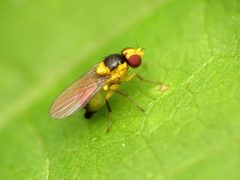
Liriomyza eupatoriella is a of leaf-mining fly in the Agromyzidae, described by Spencer in 1986. The larva creates serpentine or blotch mines within the leaves of plants. It is specifically associated with Eupatorium species (bonesets) and related including white snakeroot (Ageratina altissima). The species has been documented through 220 observations on iNaturalist, indicating it is moderately well-recorded but not extensively studied in the scientific literature.
Pronunciation
How to pronounce Liriomyza eupatoriella: //ˌlɪɹ.iˈɒmɪzə juːˌpætəɹiˈɛlə//
These audio files are automatically generated. While they are not always 100% accurate, they are a good starting point.
Identification
are small flies typical of the Liriomyza, with reduced wing venation characteristic of Agromyzidae. Larvae create internal leaf mines that appear as pale, winding trails or blotches visible on the upper and lower leaf surfaces. Mines contain (larval excrement) deposited in discrete black pellets. Specific diagnostic features distinguishing L. eupatoriella from such as L. trifolii, L. huidobrensis, and L. sativae require examination of male genitalia and chaetotaxy; these characters are described in Spencer's original 1986 description. The association with Eupatorium is a key identifying characteristic in the field.
Images
Habitat
Found in supporting its plants, including moist meadows, woodland edges, and disturbed areas where Eupatorium and related Asteraceae occur. The species requires living leaf tissue for larval development, limiting its distribution to areas with active host plant growth.
Distribution
Native distribution is not precisely documented, but the occurs in North America based on plant range and collection records. The 220 iNaturalist observations suggest established across multiple regions, though specific geographic limits remain undefined.
Diet
Larva feeds internally on leaf mesophyll tissue of Eupatorium (bonesets) and related including white snakeroot (Ageratina altissima). The feeding creates internal mines; larvae do not consume external leaf surfaces.
Host Associations
- Eupatorium - primary Larva mines leaves of Eupatorium , commonly called boneset
- Ageratina altissima - Known as white snakeroot, a related used as
Life Cycle
Complete with , larva, pupa, and stages typical of Diptera. Larval stage is the leaf-mining phase, lasting approximately 1-2 weeks depending on temperature. occurs within the leaf mine or in soil. time and number of generations per year are not documented.
Behavior
Larva exhibits endophytic feeding , tunneling between upper and lower leaf while leaving the outer surfaces intact. This mining behavior protects the larva from and desiccation. behavior including mating and oviposition patterns has not been specifically described.
Ecological Role
As a herbivore, the contributes to natural leaf and nutrient cycling in Eupatorium-dominated . densities appear limited by specificity, reducing potential for significant impact. The species serves as prey for and , though specific natural enemies are not documented.
Human Relevance
No documented economic impact. The is not known to be a pest of agricultural crops, restricted as it is to native Eupatorium and related . No management or control efforts have been described.
Similar Taxa
- Liriomyza trifoliiAgricultural pest leafminer with broader range; distinguished by host association and male genitalia
- Liriomyza huidobrensis, a serious pest of legumes and other crops; distinguished by range and thermal tolerances
- Liriomyza sativaeVegetable leafminer with broader range and different thermal ; competes with L. huidobrensis in overlapping ranges
Sources and further reading
- BugGuide
- Wikipedia
- GBIF taxonomy match
- iNaturalist taxon
- NCBI Taxonomy
- Catalogue of Life
- Liriomyza miserabilis Lonsdale dorsal | Entomology Research Museum
- Primary Type List | Entomology Research Museum
- Publications | Entomology Research Museum
- Liriomyza huidobrensis Archives - Entomology Today
- Predicting Shifts in the Range of Invasive Insect Species in the Face of Climate Change
- A Case for Preservation: Maintaining Insect Collections in Developing Countries