
Ophiomyia maura
(Meigen, 1838)
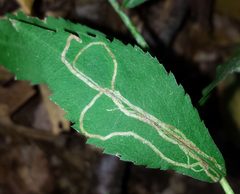
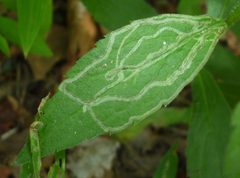
Ophiomyia maura is a leaf-mining fly in the Agromyzidae. The creates distinctive linear white mines on the upper leaf surfaces of plants in the Aster. Larvae feed selectively on palisade parenchyma tissues, exhibiting complex mining patterns that serve defensive functions against . The species has been documented from Japan, Alaska, and Manitoba, with European records from Denmark, Norway, and Sweden.
Pronunciation
How to pronounce Ophiomyia maura: /ˌɒfiəˈmaɪə ˈmɔːrə/
These audio files are automatically generated. While they are not always 100% accurate, they are a good starting point.
Identification
Mines appear as white linear tracks on upper leaf surfaces, initially following leaf margins before moving to inner leaf areas. Mine patterns feature cross structures and branches with measurable fractal dimension. Larvae feed on a single layer of palisade parenchyma , avoiding midrib and lateral . occurs on the lower leaf surface.
Images
Habitat
Deciduous -dominated sites with Aster plants. In Japan, studied in an 8×10 m² site at National Institute for Basic , Okazaki City, Aichi Prefecture.
Distribution
Japan; Alaska to Manitoba, North America; Denmark, Norway, Sweden in Europe. Vermont, USA.
Seasonality
Late April to November in Japan, with four per year. Activity associated with abundance of new leaves.
Diet
Palisade parenchyma tissues of Aster leaves. Larvae selectively feed on marginal leaf areas where nitrogen content is higher than inner leaf portions.
Host Associations
- Aster microcephalus var. ovatus - Primary in Japanese studies
- Aster ageratoides subsp. ovatus - for spatial distribution studies
- Solidago flexicaulis - True goldenrod , North America
- Solidago altissima - True goldenrod , North America
Life Cycle
Larvae mine leaves for approximately two weeks. Initial feeding occurs along leaf margins for 4-5 days toward the leaf base, then proceeds along margins to inner leaf areas. occurs on the lower leaf surface after approximately two weeks of larval development. Four per year at the Japanese study site.
Behavior
lifestyle restricted to leaf mines. Solitary occurrence on both leaf and plant . Females preferentially oviposit in newly emerged leaves. Defensive mining strategies include: (1) increased mine complexity with cross structures that confuse tracking , and (2) marginal mining for through background matching against leaf edges.
Ecological Role
Herbivorous insect subject to by idiobiont , which constitute the primary mortality factor and majority of the parasitoid . Serves as for parasitoid , with idiobiont parasitoids being superior competitors to koinobiont parasitoids.
More Details
Mine Complexity and Defense
Fractal dimension of mines increases with mine length, creating cross structures that reduce risk by confusing tracking .
Spatial Distribution Patterns
Among-plant distribution follows Poisson distribution early in season, becoming weakly clumped later. Within-plant vertical distribution shifts from middle to upper leaves during plant development as mined leaves move downward with of new growth.
Sources and further reading
- BugGuide
- Wikipedia
- GBIF taxonomy match
- iNaturalist taxon
- NCBI Taxonomy
- Catalogue of Life
- Bug Eric: City Nature Challenge 2024 Recap
- Behold the Hippoboscidae: Bizarre Biting Flies that Give Live Birth!
- Osage copperhead | Beetles In The Bush
- Spatial distributions of the leafminer Ophiomyia maura (Diptera: Agromyzidae) in host plant Aster ageratoides
- Complex Feeding Tracks of the Sessile Herbivorous Insect Ophiomyia maura as a Function of the Defense against Insect Parasitoids
- Specific Mining Pattern as a Result of Selective Feeding Within a Leaf by the Dipteran Leafminer Ophiomyia maura (Diptera: Agromyzidae)