
Madremyia saundersii
(Williston, 1889)
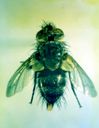
Madremyia saundersii is a tachinid fly native to North America. It specializes in attacking late-instar larvae of spruce budworm (Choristoneura fumiferana) and related tortricid moths. The has been studied extensively for its potential in programs against forest pest .
Pronunciation
How to pronounce Madremyia saundersii: /ˌmæd.rəˈmaɪ.jə ˈsɔːn.dərz.aɪ/
These audio files are automatically generated. While they are not always 100% accurate, they are a good starting point.
Images
Habitat
Coniferous forests, particularly spruce-fir stands supporting of its tortricid . Associated with forest where spruce budworm occur.
Distribution
Canada, United States, and Mexico. In Canada, documented from British Columbia and Eastern Canada (Quebec). Distribution corresponds to the range of its primary , Choristoneura fumiferana.
Seasonality
emerge in July. with single per year.
Host Associations
- Choristoneura fumiferana - primary Spruce budworm; attacks fifth- to sixth-instar larvae
Life Cycle
. Females deposit macrotype directly on larvae. Eggs hatch in 4-5 days at 24°C. Larvae develop through three instars within the host, attaching to tracheal trunks during first two instars and wandering freely during third instar. Mature larvae emerge from fifth- to sixth-instar host larvae to pupate in soil or litter. Pupal stage overwinters. Total development from egg deposition to : 17-23 days under laboratory conditions.
Behavior
Females deposit on . Preferentially attack larger host instars (fifth- to sixth-instar). Larvae emerge from host to pupate externally. from occurs in morning hours.
Ecological Role
contributing to natural regulation of spruce budworm . Member of the natural enemy complex that suppresses forest pest . Has been evaluated for use in programs through mass release.
Human Relevance
Investigated as a agent for spruce budworm management. Mass reared and released in infested areas of Eastern Canada since 1943. Generally contributes only low rates (0-5%) in field .
More Details
Reproductive Biology
Low ; females produce approximately 55-60 . Larval development is synchronized with development.
Taxonomic History
Originally described as Phorocera saundersii by Williston in 1889.