
Cuterebra abdominalis
Swenk, 1905
rabbit bot fly
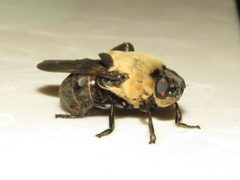
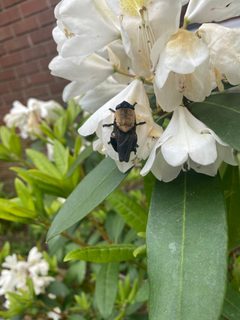
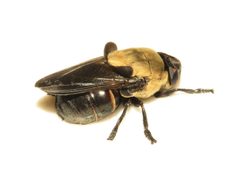
Cuterebra abdominalis is a of New World skin bot fly in the Oestridae. It is a of lagomorphs (rabbits and hares), with larvae developing subcutaneously in tissues. are short-lived, lack functional mouthparts, and do not feed. The species exhibits , resembling bumble bees in appearance. It is one of approximately 34 recognized North American species in the Cuterebra, with seven species specializing on rabbit hosts.
Pronunciation
How to pronounce Cuterebra abdominalis: //ˌkjuːtəˈriːbrə ˌæbdəˈmɪnəlɪs//
These audio files are automatically generated. While they are not always 100% accurate, they are a good starting point.
Identification
Distinguished from other Cuterebra by association (lagomorphs) and subtle morphological features. The red banding in the is characteristic of rabbit-infesting species in the , though precise identification to species level often requires expert examination and reference to specialized literature such as Sabrosky (1986). Distinguished from the similar C. buccata (also a rabbit bot fly) by specific characters detailed in taxonomic revisions. The mimicry of bumble bees can cause initial confusion with Hymenoptera, but the single pair of wings (Diptera), large size, and distinguish it.
Images
Appearance
are large, robust flies with a -like appearance. They possess large, rounded with prominent that often show red banding—characteristic of rabbit-infesting in the . The body is densely hairy, with black and yellow or orange coloration creating a tiger-striped or banded pattern on the . Wings are typically dark or smoky. Adults lack functional mouthparts. Larvae (bots) are large, thick-bodied maggots with rows of backward-pointing spines on the body segments and a pair of .
Habitat
are found in open including glades, prairies, and areas near rabbit burrows. The is associated with environments where lagomorph are abundant, including grasslands, open woodlands, and edge habitats. Larval habitat is subcutaneous within host rabbits; occurs in soil.
Distribution
Recorded from the United States, with specific records from Vermont and Missouri. The Cuterebra is distributed across North America, with individual showing varying ranges. Based on distribution, likely occurs throughout the range of suitable lagomorph hosts in eastern and central North America.
Seasonality
are active in spring and early summer, with observations in Missouri recorded in April and May. This timing coincides with the breeding season of lagomorphs. The overwinters as pupae in soil.
Diet
do not feed and lack functional mouthparts. First instar larvae enter the and migrate to subcutaneous locations. Second and third instar larvae feed on host fluids (tissue fluids and exudates) rather than solid tissue, creating a warble—a cyst-like structure with a breathing pore opening to the skin surface.
Host Associations
- Sylvilagus floridanus - larval Eastern cottontail rabbit
- Lepus - larval Hares
Life Cycle
are extremely short-lived and focus entirely on . Females lay near rabbit burrow entrances or in ; eggs are stimulated to hatch by host body heat. First instar larvae enter the host through natural orifices or skin breaks, then migrate to a subcutaneous site (often along the back or sides). The larva creates a warble—a swollen, cyst-like structure with a breathing pore—and to second instar. After approximately one month of feeding on host fluids, the third instar larva exits through the breathing pore, drops to the ground, and burrows into soil to pupate. The overwinters as a pupa, with adults emerging the following spring.
Behavior
are rarely encountered due to their short lifespan and non-feeding habit. They are most active during daylight hours in spring. Females exhibit site fidelity to areas with active rabbit burrows for oviposition. The exhibits of bumble bees, presumably reducing risk despite the adults being harmless. Larvae remain within warbles for approximately one month before exiting.
Ecological Role
As a of lagomorphs, C. abdominalis functions as a regulator of rabbit and hare populations, though are generally considered to have minimal negative impact on survival. The relatively benign host-parasite relationship reflects a long evolutionary association. serve as prey for visual that overcome or see through the mimetic protection. Pupae in soil may be subject to or by soil-dwelling organisms.
Human Relevance
Not a human . may cause momentary alarm due to mimicry and large size, but are harmless. The is of interest to entomologists studying -parasite , mimicry, and the natural history of oestrid flies. Occasionally encountered by mammalogists studying small mammals. May be observed by naturalists in spring in suitable rabbit .
Similar Taxa
- Cuterebra buccataAlso a rabbit bot fly with similar range and appearance; distinguished by subtle morphological differences in coloration and banding pattern
- Cuterebra fontinellaA rodent bot fly parasitizing mice and other small mammals; distinguished by association and lack of red banding characteristic of rabbit-infesting
- Cuterebra emasculatorA tree squirrel and chipmunk ; distinguished by association and different coloration
- Dermatobia hominisHuman bot fly of Central and South America; distinguished by geographic range, broader range including humans, and different oviposition strategy ( deposited on blood-feeding insects for transport to hosts)
- BombusBumble bees—the model for C. abdominalis mimicry; distinguished by two pairs of wings (four total), different antennal structure, and different
Misconceptions
Despite the alarming appearance of the large, -mimicking , they are harmless to humans and lack functional mouthparts. The name 'abdominalis' refers to the abdominal location of some , but this should not be confused with the warble location always being abdominal—larvae can establish warbles in various subcutaneous locations. The related species C. emasculator was historically thought to impact squirrel due to warble location near genitalia, but research has shown this is not the case; similar misconceptions about reproductive impact do not apply to C. abdominalis.
More Details
Mimicry and defense
The -like appearance of C. abdominalis is considered an example of , where a harmless gains protection from by resembling a defended or unprofitable model. The effectiveness of this mimicry is such that even knowledgeable entomologists may hesitate to handle specimens despite knowing their harmlessness.
Research challenges
Detailed study of Cuterebra , including C. abdominalis, is hampered by the difficulty of obtaining specimens. are rarely encountered alive, and species-level identification requires access to specialized taxonomic literature. The comprehensive revision by Sabrosky (1986) remains a key reference but is difficult to obtain.
Host-parasite relationship
Studies of related Cuterebra suggest that may not negatively impact survival and in some cases infected individuals have shown longer survival than uninfected counterparts. This benign relationship is attributed to the long evolutionary history between the and its specific host group.