
Cuterebra fontinella
Clark, 1827
mouse bot fly
Species Guides
2- Cuterebra fontinella fontinella(mouse bot fly)
- Cuterebra fontinella grisea
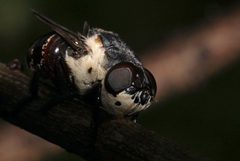
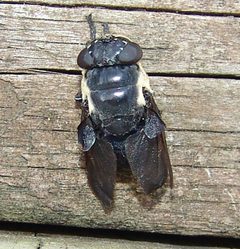
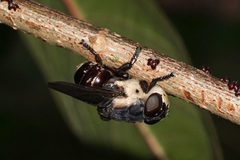
Cuterebra fontinella, commonly known as the mouse bot fly, is a New World oestrid fly that parasitizes small mammals, particularly the white-footed mouse (Peromyscus leucopus). are short-lived, non-feeding, and resemble bumble bees in appearance. Females lay on vegetation near burrows; larvae enter through natural orifices or wounds, migrate internally, and develop subcutaneous warbles typically located in the inguinal region. The exhibits bimodal seasonal activity with summer and autumn peaks. Though primarily a rodent , rare human cases of myiasis have been documented.
Pronunciation
How to pronounce Cuterebra fontinella: /kjuːtəˈɹɛbɹə fɒntɪˈnɛlə/
These audio files are automatically generated. While they are not always 100% accurate, they are a good starting point.
Identification
Distinguished from primarily by association: C. fontinella preferentially infests Peromyscus leucopus (white-footed mouse), though host specificity is not absolute. resemble bees but can be distinguished by dipteran features (single pair of wings, ). Larval identification to often requires molecular methods (COI and COII genes are reliable markers) due to morphological similarities among Cuterebra species. Two recognized: C. f. fontinella and C. f. grisea.
Images
Habitat
Deciduous forests of North America, particularly near running water and low-elevation vegetation. Highest densities occur at edges. aggregate in open, sunny areas such as roadsides with heat-reflecting surfaces and stream banks. Temperature-dependent: decreases in colder regions.
Distribution
North America, including most of the continental United States, southern Canada, and northern Mexico. varies with temperature, with warmer regions supporting higher densities.
Seasonality
Active from June through December in temperate regions, with highest rates in July and August. Bimodal produces distinct summer and autumn peaks. occurs when temperatures exceed 20°C, typically from mid-morning to early afternoon. Pupae may enter for up to 12 months during unfavorable conditions.
Host Associations
- Peromyscus leucopus - primary white-footed mouse; 19-33% rate
- Peromyscus gossypinus - secondary cotton mouse
- Peromyscus maniculatus - secondary eastern deer mouse
- Ochrotomys nuttalli - secondary golden mouse
- Lepus artemisia - secondary cottontail rabbit
- Heteromys irroratus - secondary Mexican spiny pocket mouse
- Homo sapiens - accidental rare cases of myiasis documented
Life Cycle
laid on vegetation near burrows hatch in response to host body heat and moisture. First instar larvae enter host through nose, mouth, , , or wounds, then migrate via respiratory and thoracic cavities to inguinal region. Larvae create subcutaneous warbles with breathing pores, feed on host fluids (not tissue), and develop through three instars over 3.5-4 weeks. Mature larvae exit host, burrow into soil, and pupate. emerge after approximately 50 days at 27°C, or following of up to 12 months. Adults live briefly, do not feed, and focus solely on . Females can lay up to 2000 eggs.
Behavior
Males are highly territorial, patrolling stretches of stream bank approximately 17 m long by flying figure-eight and oval patterns. Territorial defense involves chasing intruders for 10-15 minutes, with aerial grappling and tumbling to the ground when males encounter each other. Males fly 1-2 m above ground for up to 4 hours daily in sunlight; ceases if cloud cover exceeds 15 minutes. Females fly only when seeking mates. aggregate at heat-reflecting surfaces and tolerate densities up to 250 flies/km². Mating occurs on vegetation after brief aerial pursuit; copulation lasts approximately 3 minutes.
Ecological Role
of small mammals with complex - dynamics. can reduce host reproductive output (smaller litters in infected females) but has been observed to increase individual host survival, possibly due to resource reallocation from to maintenance. Multiple simultaneous infestations reduce host survival. -level effects on hosts depend on size and infestation uniformity. Threatened by pasture burning, which kills pupating larvae and alters microclimate.
Human Relevance
Rare cause of human myiasis, with 55 documented cases of Cuterebra in North America as of 1989. Larvae typically locate in benign sites (eyelid, subcutaneous tissue) but occasionally enter tracheal-pulmonary system, causing respiratory . Treatment involves larval removal; petroleum jelly applied to warble breathing hole can induce larval . Surgical removal sometimes required for ocular cases. Dead larvae in vitreous humor are absorbed without removal. Distinguished from (human bot fly of Central/South America), which uses phoretic via mosquitoes.
Similar Taxa
- Cuterebra buccataRabbit bot fly; similar appearance but infests lagomorphs rather than rodents
- Cuterebra abdominalisRabbit bot fly; -specific to lagomorphs, distinguished by host association and
- Dermatobia hominisHuman bot fly; Central/South American distribution, uses phoretic on mosquitoes, broader range
Misconceptions
The name has been misinterpreted as implying reproductive harm to ('emasculator' effect), but research shows this is unfounded; warble location near genitalia does not impair host . Additionally, while appears harmful due to visible warbles, studies indicate infected white-footed mice often survive longer than uninfected individuals, contrary to intuitive expectations about .
More Details
Ovipositor morphology
Female possesses unusually short ovipositor for Oestridae, horseshoe-shaped with dense covering of hairs, two ends, and intervening chitinous plate.
Host resistance
Previously infested develop resistance at entry points and genital region, reducing reinfection rates by 15-30% at nasal, oral, and anal sites. No resistance develops to ocular entry. Maximum antibody production occurs 28 days post-. Resistance forces larvae into atypical paths and development sites.
Genetic identification
COI and COII mitochondrial genes provide reliable discrimination where larval is ambiguous. Hybridization between Cuterebra species can complicate genetic identification.
Sources and further reading
- BugGuide
- Wikipedia
- GBIF taxonomy match
- iNaturalist taxon
- NCBI Taxonomy
- Catalogue of Life
- Diptera | Beetles In The Bush | Page 6
- Newly emerged rabbit bot fly | Beetles In The Bush
- Aggregation Behavior of Adult Cuterebra Fontinella (Diptera: Cuterebridae) in Pennsylvania, USA
- Liomys Irroratus (Rodentia: Heteromyidae), A New Host for Cuterebra Fontinella (Diptera: Cuterebridae)
- Natural and Acquired Resistance in Rodent Hosts to Myiasis by Cuterebra Fontinella (Diptera: Guterebridae)
- Development by the Laboratory Rodent Host of Humoral Antibody Activity to Cuterebra Fontinella (Diptera: Cuterebridae) Larval Antigens1
- Demography of botfly (Cuterebra fontinella) parasitism in white-footed mice (Peromyscus leucopus) in Kansas
- Increased prevalence of bot flies (Cuterebra fontinella) on white-footed mice (Peromyscus leucopus) near forest edges