
Musca autumnalis
De Geer, 1776
face fly, autumn housefly
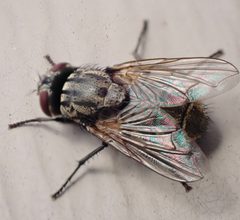
, commonly known as the or autumn housefly, is a nonbiting muscid fly native to the Palearctic region that was introduced to North America in the 1940s–1950s. are obligate pests of cattle and horses, feeding on ocular and nasal secretions, tears, saliva, and blood from wounds. The exhibits pronounced seasonal , with peak abundance in late summer and autumn, and undergoes facultative in adults triggered by short and cool temperatures. Larval development occurs exclusively in fresh cattle , where larvae feed on microbial flora and fauna.


Pronunciation
How to pronounce Musca autumnalis: /ˈmʌska ˌɔːtəmˈneɪlɪs/
These audio files are automatically generated. While they are not always 100% accurate, they are a good starting point.
Identification
are slightly larger than the housefly (), averaging 7–8 mm in length. The body is grey with four dark longitudinal stripes on the and a grey-black patterned . Males have that nearly touch when viewed from above. Distinguished from M. domestica by larger size, distinct abdominal patterning, and ecological association with cattle rather than human structures.
Images
Habitat
Pastures and agricultural landscapes associated with cattle operations. Larval development occurs exclusively in fresh cattle ; rest on vegetation at night.
Distribution
Native to most of Europe, Central Asia, northern India, Pakistan, China, and parts of North Africa. Introduced to North America around the 1940s, now distributed from southern Canada through most temperate regions of the United States. Also introduced to St. Helena Island in the South Atlantic.
Seasonality
emerge from winter hibernation in March to early April. Multiple overlapping occur through late spring and summer, with 3–10 generations per year depending on weather. peaks in late summer and autumn. Adults enter facultative in autumn, triggered by short and cool temperatures, and overwinter in protected locations.
Diet
feed on manure juices, plant sugars, and secretions from cattle and horses around , mouth, and nostrils; also feed on blood from wounds such as horse-fly bites. Females require protein from animal for ovarian development. Larvae feed on microbial flora and fauna in fresh cattle .
Host Associations
- cattle (Bos taurus) - primary obligate association; feed on secretions and larvae develop in
- horses (Equus ferus caballus) - secondary feed on secretions but larvae do not develop in horse manure
- Heterotylenchus autumnalis - that parasitizes , affecting mating and oviposition
- Thelazia spp. - transmits eyeworm Thelazia rhodesi to cattle and horses
Life Cycle
Complete with four stages: , larva (three instars), pupa, and . Females deposit eggs on fresh cow manure within 15 minutes of deposition; eggs hatch within hours. Larvae pass through three instars, reaching approximately 12 mm, then develop into white pupae. Adults emerge 10–20 days after egg deposition depending on temperature. Multiple per year with overlapping generations after the first.
Behavior
Strong on cattle , particularly around and muzzle. Pronounced seasonal fluctuations with autumn peaks. avoid direct sunlight and high temperatures; rest on vegetation at night. of several kilometers documented. Females show higher fidelity to than males due to protein requirements for development.
Ecological Role
Larvae function as decomposers in . Competitor with other dung-inhabiting insects including other dipteran larvae. Potential for competitive exclusion of pest flies in dung. serve as intermediate and for parasitic including Thelazia eyeworms.
Human Relevance
Significant pest of cattle and horses causing irritation, reduced weight gains, and potential transmission. of Thelazia rhodesi (eyeworm) and suspected vector of infectious bovine keratoconjunctivitis (pinkeye). Documented case of Thelazia gulosa transmission to human in Oregon (2016) and California (2018). On-farm control by conventional means has proven ineffective due to and mobility; and sterile insect technique suggested as alternatives.
Similar Taxa
- Musca domesticaSimilar size and general appearance; distinguished by smaller size (6–7 mm), less distinct abdominal patterning, association with human structures rather than cattle, and four thoracic stripes that are less sharply defined
- Stomoxys calcitransBoth are cattle-associated muscid flies; distinguished by S. calcitrans being a blood-feeding biter with piercing mouthparts, while M. autumnalis is nonbiting and feeds only on secretions and wound blood
More Details
Parasite-mediated behavior modification
The Heterotylenchus autumnalis parasitizes face flies and has been observed to affect mating and oviposition in infected . The of the fly and nematode are synchronized, with both entering in autumn and together.
Larval distribution in dung
larvae exhibit specific horizontal and vertical distribution patterns within pats in response to temperature and moisture gradients, positioning themselves to optimize developmental conditions.
Sources and further reading
- BugGuide
- Wikipedia
- GBIF taxonomy match
- NCBI Taxonomy
- Catalogue of Life
- House Fly Resistance to One Neonic Insecticide Doesn't Extend to Others, Study Shows
- Why the House Fly Should Join the Ranks of Agricultural Waste Recyclers
- Forensic Entomologists Mite Start Looking at Acarids for Clues
- Do House Flies Bother Cattle Enough to Interrupt Their Feeding?
- Playing mind games with the seedcorn maggot, Delia platura — Bug of the Week
- Super Crop Challenge #4 | Beetles In The Bush
- BIONOMICS OF THE FACE FLY, MUSCA AUTUMNALIS
- Distribution of haemocytes in larvae of Musca domestica and Musca autumnalis and possible chemotaxis during parasitization
- Effects of Parasitization by the Nematode, Heterotylenchus autumnalis, on Mating and Oviposition in the Host, Musca autumnalis
- The synchronization of the life cycle of diapausing face flies, Musca autumnalis, and of the nematode, Heterotylenchus autumnalis
- Prehibernating Musca autumnalis (Diptera: Muscidae) — an overwintering host for parasitic nematodes
- The face fly, Musca autumnalis De Geer, and aggregation behavior in Holstein cows
- Horizontal and vertical distribution of face fly larvae (Musca autumnalis) in response to temperature and moisture gradients in dung pats
- Review Article 1:Biology and Control of the Face Fly, Musca Autumnalis (Diptera: Muscidae)
- Geographic Range and Temporal Patterns of Parasitization of Musca Autumnalis (Diptera: Muscidae) by Thelazia Sp. (Nematoda: Spirurata) in Massachusetts, with Observations on Musca Domestica (Diptera: Muscidae) as an Unsuitable Intermediate Host1