
Ephydra
Fallén, 1810
brine flies, alkali flies
Species Guides
1- Ephydra gracilis(Brine Fly)
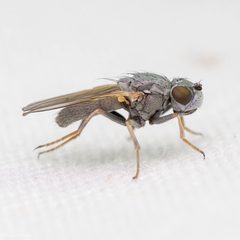
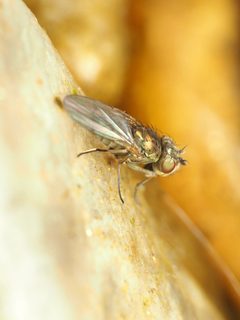
Ephydra is a of shore flies (Ephydridae) with distribution. Several are notable for inhabiting extreme environments, including hypersaline lakes and hot springs. The genus includes the alkali fly (Ephydra hians), which forms dense in alkaline lakes such as Mono Lake, California, and serves as a critical food source for migratory birds. Larvae are aquatic or semi-aquatic, with morphological adaptations for feeding and respiration in mineral-rich waters.
Pronunciation
How to pronounce Ephydra: //ˈɛ.fɪ.drə//
These audio files are automatically generated. While they are not always 100% accurate, they are a good starting point.
Identification
Ephydra are distinguished from other Ephydridae by combinations of genitalic and chaetotaxic characters. The subgenus Hydropyrus (containing E. hians) is recognized by specific morphological traits. Larvae can be identified to instar by pigmentation and spine patterns. Species-level identification requires examination and is often based on male genitalia.
Images
Habitat
Diverse aquatic and semi-aquatic environments including hypersaline lakes, hot springs, salt marshes, and alkaline waters. -specific preferences range from extreme mineralized waters (E. hians, E. cinerea) to agricultural saline fields (E. macellaria).
Distribution
. Documented from North America (including Great Salt Lake, Mono Lake, Abert Lake), Europe (Denmark, Norway, Sweden), Central Asia, New Zealand, Japan, and other regions.
Seasonality
Activity patterns vary by and latitude. E. macellaria in Central Asian rice fields shows first- from mid-May to early June at 18-20°C air temperatures.
Diet
Larvae and feed on microorganisms. In hot springs, both life stages consume and bacteria. In saline lakes, larvae graze on benthic microbial and plankton.
Life Cycle
Holometabolous with , larval, pupal, and stages. Larval development includes at least three instars. Duration and are plastic in response to food availability.
Behavior
of E. hians exhibit superhydrophobic properties enabling them to dive into alkaline waters to lay and feed without wetting. Larvae possess specialized respiratory siphons for aquatic environments.
Ecological Role
Primary consumer in aquatic , transferring microbial production to higher . E. hians and E. cinerea are keystone prey for migratory shorebirds (particularly phalaropes) at saline lakes. Contributes to nutrient mineralization in hot spring .
Human Relevance
E. macellaria is a documented pest in saline agricultural fields, requiring chemical control measures. E. hians and E. cinerea support ecotourism and ecological research at Mono Lake and Great Salt Lake. The serves as a model system for studying to extreme environments.
Similar Taxa
- ParacoeniaAlso inhabits hot springs and feeds on microorganisms; distinguished by morphological and ecological traits not detailed in available sources.
- ScatellaShares saline preferences but differs in larval and chaetotaxy.
More Details
Extreme Environment Adaptation
E. hians has evolved specialized cuticular chemistry and microstructure producing superhydrophobicity, allowing exploitation of alkaline waters toxic to most insects. This represents with other extreme-environment .
Population Ecology
E. cinerea is the only benthic metazoan in Great Salt Lake, making it a unique system for studying in simple . E. hians shows differences between Mono Lake and Abert Lake correlated with characteristics.
Sources and further reading
- BugGuide
- Wikipedia
- GBIF taxonomy match
- iNaturalist taxon
- NCBI Taxonomy
- Catalogue of Life
- External morphology of the larvae of Ephydra (Hydropyrus) hians (Diptera: Ephydridae)
- Feeding by Paracoenia and Ephydra (Diptera> Ephydridae) on the Microorganisms of Hot Springs
- SHOLI EKILAYOTGAN MAYDONIDAGI (EPHYDRA MACELLARIA EGGER) NI ZIYON KELTIRISH VAQTINI ANIQLASH HAMDA UNGA QARSHI KURASH SAMARADORLIGI
- Distribution and abundance of the alkali fly (Ephydra hians) Say at Mono Lake, California (USA) in relation to physical habitat
- Comparative population ecology of Ephydra hians Say (Diptera: Ephydridae) at Mono Lake (California) and Abert Lake (Oregon)
- Developmental Responses to Food Limitation as Indicators of Environmental Conditions for Ephydra Cinerea Jones (Diptera)
- Comparative population ecology of Ephydra hians Say (Diptera: Ephydridae) at Mono Lake (California) and Abert Lake (Oregon)
- Population ecology of Ephydra cinerea Jones (Diptera: Ephydridae), the only benthic metazoan of the Great Salt Lake, U.S.A.
- Distribution and abundance of the alkali fly (Ephydra hians) Say at Mono Lake, California (USA) in relation to physical habitat
- Spatial and Temporal Distribution of Phalaropes (Phalaropus spp.) and Adult Brine Flies (Ephydra spp.) are Linked on Great Salt Lake, Utah
- Superhydrophobic diving flies ( Ephydra hians ) and the hypersaline waters of Mono Lake