
Cirrula hians
(Say, 1830)
Alkali Fly
Cirrula hians, commonly known as the alkali fly, is a brine fly in the Ephydridae. This is notable for its association with alkaline and saline aquatic . The species was originally described by Thomas Say in 1830 under the name Ephydra hians. It has been documented in 474 iNaturalist observations, indicating moderate public awareness and detectability. The species serves as an important food source for migratory birds and has been historically harvested by peoples of the Mono Lake region.
Pronunciation
How to pronounce Cirrula hians: /ˈsɪr.jʊ.lə ˈhaɪ.ənz/
These audio files are automatically generated. While they are not always 100% accurate, they are a good starting point.
Identification
Accurate identification of Cirrula hians requires examination of genitalia and specific chaetotaxy patterns. The is superficially similar to other Ephydridae in alkaline , particularly other Cirrula species and Ephydra spp. Separation from relies on microscopic characters not visible in field observations. Historical confusion with Ephydra hians (the original combination) has been resolved through taxonomic revision placing the species in Cirrula.
Images
Appearance
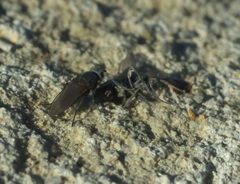
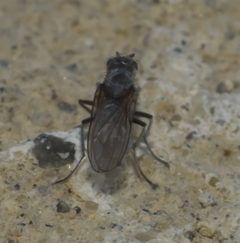
are small flies typical of the Ephydridae , with reduced wing venation characteristic of brine flies. Larvae are aquatic and adapted to high-salinity environments. Specific morphological details distinguishing C. hians from require examination of genitalia and chaetotaxy.
Habitat
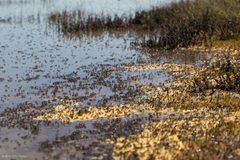
Aquatic and semi-aquatic with high alkalinity and salinity, including alkaline lakes, salt marshes, and saline ponds. The is specifically associated with Mono Lake, California, where it forms dense larval in the highly alkaline waters (pH ~9.8, salinity roughly 2.5 times seawater).
Distribution
Western North America, with well-documented at Mono Lake, California. The occurs in suitable alkaline lake across the arid western United States and possibly into adjacent regions of Mexico.
Seasonality
are active during warmer months when water temperatures support larval development. At Mono Lake, peak adult and activity occurs from spring through fall, with specific timing influenced by water temperature and food availability.
Diet
Larvae feed on benthic and organic detritus in alkaline waters. do not feed extensively; if they feed at all, it is on nectar or surface films. The larval diet is specifically adapted to the microbial of high-pH, high-salinity environments.
Life Cycle
Holometabolous with complete . are laid on submerged substrates in alkaline waters. Larvae are aquatic, passing through three instars while feeding on benthic resources. occurs within the larval . emerge to mate and disperse. The is continuous during favorable conditions, with overlapping .
Behavior
Larvae form dense on underwater substrates, creating conspicuous mats visible from the surface. are known for their mass events at Mono Lake, where they accumulate in windrows along shorelines. The demonstrates remarkable physiological to extreme alkalinity and salinity. Larvae possess specialized mechanisms for in hypersaline conditions. Adults are capable of underwater on the lake surface film to deposit , aided by hydrophobic body hairs that trap air.
Ecological Role
Primary consumer in alkaline lake , converting benthic into insect . Serves as a critical food resource for migratory birds, particularly at Mono Lake where the supports large of nesting and migratory waterbirds including phalaropes and other shorebirds. The species contributes to nutrient cycling in extreme aquatic environments where few other macroinvertebrates can survive.
Human Relevance
Historically harvested by Kutzadika'a people (Mono Lake Paiute) as a dietary staple; larvae were collected, dried, and processed into a nutritious food known as kutsavi. The has become a subject of ecological research and conservation interest due to its role in supporting Mono Lake's internationally important bird . Water diversions that lowered Mono Lake's level threatened the species and prompted legal protection of the lake . The species illustrates both traditional human food use of insects and modern conflicts over water resources in arid regions.
Similar Taxa
- Ephydra spp.Other brine flies in the same share alkaline preferences and general ; distinguished by genitalic and chaetotaxy characters
- Other Cirrula species occur in similar and require detailed examination for separation; C. hians is the most abundant and well-known member of the at Mono Lake
- Paracoenia spp.Other ephydrid flies in alkaline lakes; generally smaller and with different
More Details
Taxonomic History
Originally described as Ephydra hians by Thomas Say in 1830, this was later transferred to the Cirrula based on morphological revision. The synonym Ephydra hians persists in some literature and databases.
Mono Lake Ecology
Cirrula hians is the macroinvertebrate in Mono Lake, with larval densities reaching thousands per square meter in favorable . The ' productivity is directly tied to lake level and salinity, making it sensitive to water management decisions.
Cultural Significance
The Kutzadika'a people's traditional harvest of kutsavi represents one of the best-documented cases of in North America, contrasting with the 'yuck factor' discussed in Western contexts. This traditional use was sustainable and integrated with ecological understanding of the lake system.