
Sympycninae
Genus Guides
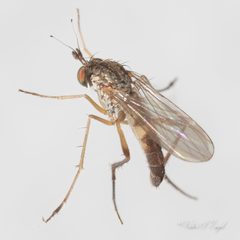
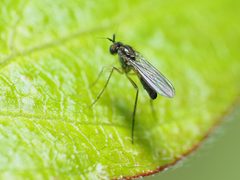
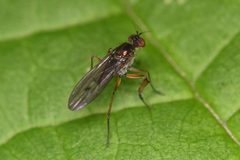
5Sympycninae is a of long-legged flies (Dolichopodidae) containing over 30 distributed across all major biogeographic regions. The subfamily exhibits considerable morphological diversity and has undergone significant taxonomic revision, with some classifications incorporating the former subfamilies Peloropeodinae and Xanthochlorinae. Notable genera include Sympycnus, Syntormon, Campsicnemus, and the Australian Yumbera.
Pronunciation
How to pronounce Sympycninae: /sɪmˈpɪksɪni.aɪ/
These audio files are automatically generated. While they are not always 100% accurate, they are a good starting point.
Identification
Sympycninae can be distinguished from other dolichopodid by combinations of wing venation characters, male genitalic structures, and leg chaetotaxy. The subfamily lacks the distinctive features of Diaphorinae (flattened male fore ) and Hydrophorinae (elongated and tibiae of aquatic ). Generic identification relies on subtle differences in structure, separation, and hypopygial . Species-level identification typically requires examination of male terminalia; female specimens are often difficult to identify due to reduced secondary sexual characteristics.
Images
Habitat
occur in diverse including moist forests, grasslands, and semi-aquatic environments. The Australian Yumbera is confined to moist eastern forests from northern Queensland to Victoria. In Iran, species have been collected in mixed grasslands with Asteraceae, Apiaceae, Leguminaceae, Poaceae and Ranunculaceae, and various crops at elevations of 1803-3005 m.
Distribution
distribution with records from all major biogeographic regions: Nearctic, Neotropical, Palaearctic (Europe, Caucasus, Central Asia, Iran), Oriental, and Australasian (Australia). The Calyxochaetus is restricted to the New World. The genus Campsicnemus has a broad Palaearctic distribution including Europe and Iran. The genus Yumbera is to eastern Australia.
Diet
on soft-bodied insects including aphids, mites, and . Some Dolichopodidae feed on nectar.
Behavior
Campsicnemus umbripennis occurs in dense in the Kandovan region of Iran, while most other in that area were found in small populations suggesting rarity in north-western Iran.
Similar Taxa
- PeloropeodinaeSometimes included within Sympycninae in broader classifications; distinguished by historical rather than clear-cut morphological boundaries
- XanthochlorinaeSometimes treated as part of Sympycninae; separation based on subtle genitalic and leg characters that may not warrant status
- DiaphorinaeDistinguished by flattened male fore and different wing venation patterns
- HydrophorinaeDistinguished by elongated and tibiae associated with more strictly aquatic habits
More Details
Taxonomic instability
The circumscription of Sympycninae varies among authors. Some classifications subsume Peloropeodinae and Xanthochlorinae within Sympycninae, while others maintain them as separate . This reflects ongoing uncertainty about phylogenetic relationships within Dolichopodidae.
Notable genera
Sympycnus and Syntormon are large, widespread . Campsicnemus is notable for its broad distribution and recent first record from Iran. Yumbera is a distinctive Australian genus described in 1992. Calyxochaetus is a diverse New World genus with 36 recognized classified into five species groups.
Sources and further reading
- BugGuide
- Wikipedia
- iNaturalist taxon
- NCBI Taxonomy
- Catalogue of Life
- Revision of the genus Calyxochaetus Bigot (Diptera: Dolichopodidae: Sympycninae)
- New Faunistic Records of the Subfamily Sympycninae (Diptera, Dolichopodidae) from Iran
- The Australian Sympycninae (Diptera : Dolichopodidae): Introduction and description of a new genus, Yumbera