
Campsicnemus
Haliday, 1851
Species Guides
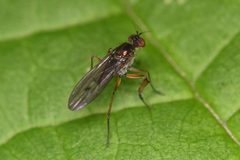
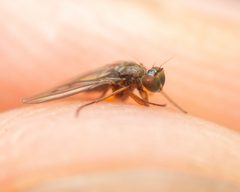
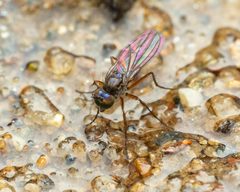
5Campsicnemus is a of long-legged flies (Dolichopodidae) comprising over 300 described . The genus exhibits exceptional diversity in the Hawaiian Islands and French Polynesia, where more than 170 species have been described with estimates of 250–300 total species. Some Hawaiian species are flightless. The genus name refers to the curved or modified mid tibia of males, a prominent secondary sexual character.
Pronunciation
How to pronounce Campsicnemus: /ˌkæmpˌsɪkˈniːməs/
These audio files are automatically generated. While they are not always 100% accurate, they are a good starting point.
Identification
Males possess a distinctively modified mid tibia—a secondary sexual character that gives the its name (from Greek 'kampis' for curve and 'kneme' for tibia). In the Campsicnemus armatus group, the mid tibia bears a comb-like posteroventral row of blunt-ended bristles. Some Hawaiian species are wingless. Species-level identification requires examination of male genitalia and leg modifications.
Images
Distribution
The has a highly uneven global distribution: over 170 described from Hawaii with an estimated 250–300 species total in the Hawaiian Islands and French Polynesia; 39 Palearctic species; 22 Nearctic species; seven Afrotropical species; and seven Indomalayan species. GBIF records confirm presence in Denmark, Norway, and Sweden.
Human Relevance
Flightless Hawaiian have been severely impacted by ants and introduced wild boar (Sus scrofa), with some species believed extinct following these introductions.
More Details
Etymology
The generic name derives from Ancient Greek καμψις ('curve') and κνημη ('tibia'), referring to the modified mid tibia of males.
Conservation concern
The high diversity in Hawaii, combined with flightlessness in some , makes certain Campsicnemus particularly vulnerable to and disturbance.