
Sympycnus
Loew, 1857
Species Guides
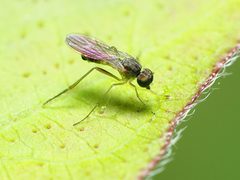
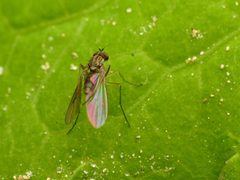
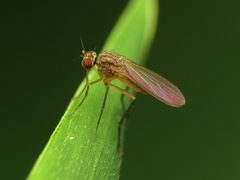
1Sympycnus is a of long-legged flies (Dolichopodidae) established by Loew in 1857. occur across Europe and the East Palaearctic, including Russia, Kazakhstan, Kyrgyzstan, Tajikistan, and Uzbekistan. Taxonomic revision has resolved substantial confusion in European species, particularly consolidating multiple synonyms under S. pulicarius and describing S. septentrionalis as a distinct northern species.
Pronunciation
How to pronounce Sympycnus: /sɪmˈpɪknʊs/
These audio files are automatically generated. While they are not always 100% accurate, they are a good starting point.
Identification
S. pulicarius is distinguished from S. septentrionalis by the presence of a posteroventral bristle on the mid tibia; the particular chaetotaxy and relative lengths of tarsomeres of the male hind are also consistent diagnostic features. The postpedicel in S. pulicarius shows substantial variation in shape and size and is not a reliable distinguishing character. East Palaearctic can be identified using the key provided by Negrobov (2016), which defines five species groups.
Images
Habitat
Open grassy . In Belgium, S. pulicarius is most abundant in such environments. S. septentrionalis exhibits similar habitat preference but is confined to northern Europe.
Distribution
Europe: widespread, with S. pulicarius most common in western Flanders (Belgium); S. septentrionalis restricted to northern Europe. East Palaearctic: Russia (Yakutia), Kazakhstan, Kyrgyzstan, Tajikistan, Uzbekistan. Records from Denmark, Norway, and Sweden.