
Culex tarsalis
Coquillett, 1896
Western Encephalitis Mosquito
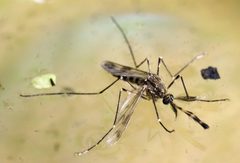
Culex tarsalis is a mosquito distributed across North America, with particular importance in the western United States as a of multiple . The species is distinguished by black and white banding on the legs. It serves as the primary vector for West Nile virus in agricultural areas of California and transmits Saint Louis virus, Western equine encephalitis virus, and . Some exhibit autogeny, the ability to produce without blood feeding. The species has been the subject of extensive genetic research, with a reference published in 2020.

Pronunciation
How to pronounce Culex tarsalis: //ˈkjuːlɛks tɑːrˈsælɪs//
These audio files are automatically generated. While they are not always 100% accurate, they are a good starting point.
Identification
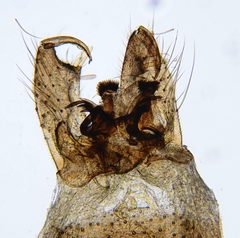
Distinguished from other Culex by the prominent black and white banding on the (legs). Can be separated from Culex quinquefasciatus (southern house mosquito) by leg banding pattern and geographic distribution. Molecular identification via c oxidase subunit I (COI) gene sequencing confirms morphological identifications. In Florida, recently distinguished from Culex declarator by molecular methods.
Images
Appearance
Habitat
Breeds in standing freshwater including artificial containers, pools, and wetlands. In California urban environments, abundance increases following rainfall. Associated with agricultural areas where West Nile virus is highest. Larval development occurs in aquatic ; found in terrestrial environments near breeding sites.
Distribution
North America, with range extending from Canada through the United States into Mexico. Three genetically distinct clusters identified in the western United States: Pacific, Sonoran, and Midwest. Documented in Florida as a new county record in Collier County (2021), though establishment status uncertain. Absent from extreme northern temperate zones.
Diet
Females blood-feed on vertebrate ; specific host not documented in available sources. Males feed on nectar and other sugar sources. can produce initial batch without blood meal.
Life Cycle
Complete with , larval, pupal, and stages. Larval and pupal stages aquatic. detected in larval and pupal stages but no protein production during this period. strains can mature initial egg batch without blood feeding; subsequent gonotrophic cycles require blood meal.
Behavior
Exhibits as strategy. -seeking activity influenced by temperature and time of day, affecting efficacy of chemical control interventions. Oviposition responds to associated with fish, which has been investigated for potential control applications. Autogeny documented in certain .
Ecological Role
Key for zoonotic in western North America. Principal vector for West Nile virus in California agricultural areas. Transmits Saint Louis virus, Western equine encephalitis virus, and (Plasmodium species affecting wild birds). Serves as for viral superinfection exclusion interactions (Eilat virus vs. West Nile virus).
Human Relevance
Major public health concern due to competence for multiple human . Target of surveillance and control programs in western United States. Subject of research on natural mosquito control through wetland management. sequenced to facilitate studies on resistance, , and sex determination.
Similar Taxa
- Culex quinquefasciatusClosely related sister with overlapping distribution in southern North America; distinguished by leg banding pattern, genetic divergence estimated at 15.8-22.2 million years, and smaller size (578 Mb vs. 790 Mb)
- Culex restuansSympatric in some areas; distinguished by oviposition and morphological differences in larval and stages
- Culex declaratorRecently documented in same Florida county; distinguished by molecular identification and morphological characters
More Details
Genomic Resources
First reference (CtarK1) assembled in 2020: 790 Mb with 17,456 protein-coding genes annotated. Genome 27% larger than C. quinquefasciatus due primarily to expansion. Contains voltage-gated sodium channel (VGSC) gene with kdr resistance mutation. Sex determination locus mapped to 3.
Population Structure
At least three geographically distinct genetic clusters identified in western North America: Pacific, Sonoran, and Midwest. genetic analyses have informed understanding of -borne and surveillance strategies.
Sources and further reading
- BugGuide
- Wikipedia
- GBIF taxonomy match
- iNaturalist taxon
- NCBI Taxonomy
- Catalogue of Life
- CLBL Event on May 15: UC Davis Medical Entomologist to Discuss Natural Mosquito Control | Bug Squad
- Watch the Science of Entomology Unfold at Bohart Museum of Entomology Open House | Bug Squad
- An 'Invasion' of Household Vampires at the Bohart Museum of Entomology | Bug Squad
- Don't Miss the Wetlands Restoration Exhibit | Bug Squad
- When Harry (Hoogstraal) Met Bill (Reisen) | Bug Squad
- Bohart Museum Open House: Learn About Mosquitoes, Ticks, Bed Bugs, Lice, and Fleas | Bug Squad
- Whole-genome assembly of Culex tarsalis
- Whole genome assembly of Culex tarsalis
- Vitellogenin gene expression in autogenous Culex tarsalis
- Oviposition Behavior of Natural Populations of Culex tarsalis and Culex restuans (Diptera: Culicidae) in Artificial Pools
- Figure 1: USA distribution by state of Anopheles freeborni, Anopheles quadrimaculatus, and Culex tarsalis (Hayes et al., 2005; Venkatesan & Rasgon, 2010; Manguin, 2013).
- Aedes tortilis, Culex declarator, and Culex tarsalis: New County Records for Mosquito Species in Collier County, Florida
- Teasing apart the ovipositional responses of Culex tarsalisto semiochemicals associated with fish for use in vector control
- Virome profiling of Culex tarsalis through small RNA-seq: A challenge of suboptimal samples.
- Eilat virus (EILV) causes superinfection exclusion against West Nile virus (WNV) in a strain-specific manner in Culex tarsalis mosquitoes.
- A single-cell atlas of the Culex tarsalis midgut during West Nile virus infection.
- Co-Infection of Culex tarsalis Mosquitoes with Rift Valley Fever Phlebovirus Strains Results in Efficient Viral Reassortment.
- Temperature and time of host-seeking activity impact the efficacy of chemical control interventions targeting the West Nile virus vector, Culex tarsalis.