
Culex restuans
Theobald, 1901
White-dotted Mosquito
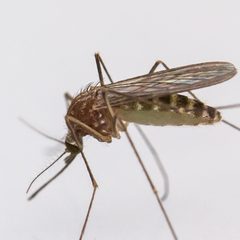
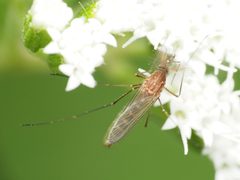
Culex restuans is a medium-sized brown mosquito distributed across North America, Central America, and the Caribbean. It is a significant of West Nile virus and St. Louis , serving as both an enzootic vector among birds and a potential bridge vector to mammals. are occasionally called the 'white-dotted mosquito' due to two white dots sometimes present on the , though these are not reliable identification characters. The is frequently confused with Culex pipiens, requiring detailed morphological examination for accurate identification.
Pronunciation
How to pronounce Culex restuans: /ˈkjuːlɛks rɛsˈtwɑːnz/
These audio files are automatically generated. While they are not always 100% accurate, they are a good starting point.
Identification
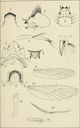
Culex restuans is extremely similar in appearance to Culex pipiens, and the two cannot be reliably distinguished by the presence or absence of white scutal dots alone. Five characters have been identified as reliable for distinguishing these species in Minnesota and Wisconsin : (1) coloration and number of erect on the area of the , (2) number of setae on the upper thoracic proepisternum, (3) coloration of prepostnotal setae, (4) coloration of setae on the mid-lobe of the scutellum, and (5) coloration of wing remigial setae. Larvae are distinguished from other Culex species by having at least three long, individually placed setae on the siphon rather than setae in groups or tufts. Molecular identification may be necessary for definitive separation from Cx. pipiens in some regions.
Images
Habitat
stages develop in standing water ranging from clean to polluted, commonly in small artificial containers including discarded vehicle tires. In California, larvae have been found in artificial freshwater pools with emergent vegetation such as sedges and cattails, with rafts deposited primarily at pool edges near vegetation. Larvae avoid pools with floating or submerged vegetation. occupy woodland areas including deciduous forests with oak, ash, maple, and hackberry, as well as residential neighborhoods.
Distribution
Native to North America with established in Canada, the United States, Mexico, Guatemala, Honduras, and the Bahamas. Common in the northeastern United States, Great Lakes region, and Midwest; specifically studied populations in Cook County and Champaign County, Illinois, and Kern County, California.
Seasonality
Peak oviposition activity occurs in June-July in California . are strongly driven by ambient temperature and precipitation, with activity patterns varying geographically. has been documented but specific seasonal timing varies by region.
Diet
Female are opportunistic blood-feeders that primarily feed on birds, with occasional feeding on mammals including humans. The frequency of human biting is disputed among sources. Larvae feed on microorganisms and surface biofilms in aquatic ; specific dietary components remain largely unknown but laboratory colonies are maintained on fish food, rabbit pellets, and liver powder.
Life Cycle
Holometabolous with , larval, pupal, and stages. Gravid, blood-fed females lay floating egg rafts on standing water. Development from egg to adult can occur in as few as 10 days in water with abundant organic matter. Larvae pass through four instars before pupating. Females exhibit oviposition site selection , decreasing egg-laying in containers with preexisting larvae and preferring nutrient-rich water sources.
Behavior
Females exhibit selective oviposition , requiring emergent vegetation as a cue for -laying site selection. In sympatric situations with Culex tarsalis, partitioning occurs through differential oviposition site selection. Females demonstrate skip-oviposition tendencies by distributing eggs across multiple sites. Larval presence significantly alters bacterial composition in container habitats, suppressing certain bacterial while enhancing others.
Ecological Role
Important enzootic and bridge of West Nile virus and St. Louis virus. Serves as an amplifying vector due to preference for avian , with potential to transmit to mammals. Larvae play a key role in structuring microbial in container aquatic , reducing bacterial abundance, diversity, and richness while selectively enhancing or suppressing specific bacterial . This activity may alter decomposition processes and dynamics in these systems.
Human Relevance
Primary significance is as a of West Nile virus and St. Louis , contributing to human risk in North America. The is a target of mosquito control programs using synthetic , , methoprene, Bacillus thuringiensis israelensis, and Lysinibacillus sphaericus. show increasing resistance, particularly to methoprene and pyrethroids. The fungus Erynia conica has been investigated as a potential agent.
Similar Taxa
- Culex pipiensNearly identical in general appearance; historically confused due to unreliable white scutal dot character. Distinguished by specific setal coloration and arrangement characters on , , and wings, though these may vary geographically.
- Culex tarsalisSympatric in western North America; distinguished by different oviposition site preferences, with Cx. restuans selecting emergent vegetation and Cx. tarsalis using different types.
Misconceptions
The 'white-dotted mosquito' and the presence of two white dots on the are not reliable identification characters, as these can fall off and some individuals lack them entirely. This has led to frequent misidentification as Culex pipiens.
More Details
Bacterial Associations
rafts harbor bacterial dominated by Novosphingobium, distinct from communities dominated by Providencia. Bacterial richness is higher in egg rafts than midguts. Larvae harbor distinct and less diverse bacterial communities compared to their aquatic .
Interspecific Interactions
When reared with Culex pipiens, larval microbial become more similar between than when reared separately, indicating that interspecific interactions shape composition.
Sources and further reading
- BugGuide
- Wikipedia
- GBIF taxonomy match
- iNaturalist taxon
- NCBI Taxonomy
- Catalogue of Life
- Are Culex Mosquitoes Potential Vectors of the Zika Virus? | Bug Squad
- Breaking News: Zika Virus Found in Wild-Caught Culex | Bug Squad
- Mosquito Sprays Can Reduce West Nile Virus, Even If Populations Don't Drop
- Even at the Zoo, Mosquitoes Favor Local Wild Birds for Meals
- Unique Egg-Laying Behavior Re-Discovered in Culex Mosquito Species
- Bloodsuckers in the basement: Subterranean mosquito, Culex pipiens form molestus — Bug of the Week
- Oviposition Behavior of Natural Populations of Culex tarsalis and Culex restuans (Diptera: Culicidae) in Artificial Pools
- Culex pipiens and Culex restuans egg rafts harbor diverse bacterial communities compared to their midgut tissues
- Predicting Culex pipiens/restuans population dynamics using a weather driven dynamic compartmental population model
- Culex pipiens L. and Culex restuans egg rafts harbor diverse bacterial communities compared to their midgut tissues
- A Preliminary Study of the Seasonal Geographic Distribution and Overwintering of Culex Restuans Theobald and Culex Salinarius Coquillet (Diptera: Culicidae)
- Field Evidence for Multiple Host Contacts During Blood Feeding by Culex tarsalis, Cx. restuans, and Cx. nigripalpus (Diptera: Culicidae)
- Culex pipiens and Culex restuans larval interactions shape the bacterial communities in container aquatic habitats
- Geospatial variability in the egg raft distribution and abundance of Culex pipiens and Culex restuans in Urbana‐Champaign, Illinois
- Predicting Culex pipiens/restuans Population Dynamics Using a Weather-Driven Dynamic Compartmental Population Model
- Culex restuans(Diptera: Culicidae) Oviposition Behavior Determined by Larval Habitat Quality and Quantity in Southeastern Michigan
- Microbial communities of container aquatic habitats shift in response to Culex restuans larvae