
Culex pipiens
Linnaeus, 1758
common house mosquito, northern house mosquito
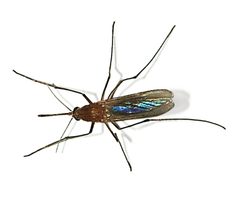
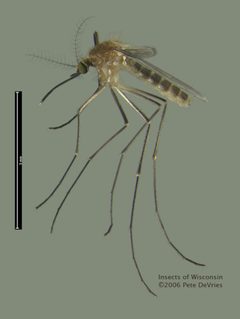
Culex pipiens is a globally distributed mosquito native to Africa, Asia, and Europe, now found in temperate regions worldwide except Antarctica. It is the type species for the Culex and one of the most common mosquitoes in human in the northern hemisphere. The species includes two morphologically indistinguishable but ecologically distinct forms: C. p. form pipiens, which lives above ground and feeds primarily on birds, and C. p. form molestus, which lives underground and bites mammals including humans. Hybrids between these forms exhibit intermediate feeding and are implicated as bridge for West Nile virus transmission from birds to humans.
Pronunciation
How to pronounce Culex pipiens: //ˈkjuːlɛks ˈpɪpiɛnz//
These audio files are automatically generated. While they are not always 100% accurate, they are a good starting point.
Images
Habitat
Culex pipiens thrives in urban and suburban environments with standing water containing organic matter. Natural larval include marshes, pools, streams, and shallow ponds. Artificial habitats include barrels, sewage ditches, gutters, cesspits, and intermittent puddles. Form pipiens occupies above-ground habitats with open water sources. Form molestus exploits subterranean habitats including basements, sewers, underground subway tunnels, and buried water holding tanks, allowing year-round activity buffered from seasonal temperature changes.
Distribution
Native to Africa, Asia, and Europe. Now widely distributed in temperate regions on every continent except Antarctica. Abundant in cities, particularly those with poor wastewater management. Most common mosquito in northern regions of the United States.
Seasonality
Activity varies by region and climate. Breeding typically begins when temperatures reach 10°C (50°F). Form pipiens females enter reproductive during winter, in sheltered locations such as basements, sheds, and caves in a state of -seeking arrest. Form molestus remains active year-round due to underground buffered from seasonal cold. Artificial light at night can disrupt diapause, causing females to become reproductively active during autumn and winter.
Diet
Females feed on vertebrate blood including birds, humans, and cattle as a protein source for production. Form pipiens preferentially feeds on birds, particularly associated with human habitation such as doves and pigeons. Form molestus frequently bites mammals including humans. Males feed exclusively on sugar sources including plant nectar, floral nectar, and honeydew. Females also consume sugar sources, with increased nectar feeding before winter to store fat. Peak feeding activity occurs during early evening hours.
Life Cycle
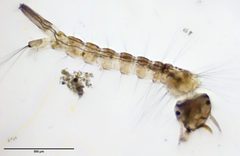
Females lay in rafts of 150 or more eggs that float on water surfaces. Larvae develop in water over 7–10 days, feeding on organic particles and bacteria. Pupae remain at the water surface for 1–3 days before . Total development from larva to adult takes 20–25 days under optimal conditions. Form pipiens requires a blood meal before laying eggs (anautogeny). Form molestus can lay one initial batch of eggs without blood feeding (autogeny) due to larval-derived protein reserves, but requires blood for subsequent egg batches.
Behavior
Females locate using visual and chemical cues including carbon dioxide and lactic acid. Feeding involves activation, orientation, landing, and probing stages. Mating occurs in swarms or while females are resting; swarming is not essential for successful copulation. Form pipiens mates in open spaces. Form molestus mates in confined underground spaces. Females may perform rejection kicks to deter courting males, though males can still achieve copulation afterward. Males use antennal fibrillae to locate females; females use them to locate hosts.
Ecological Role
Major of West Nile virus, Saint Louis virus, (Plasmodium relictum), and filarial worms. Form pipiens maintains transmission cycles among bird . Form molestus transmits to mammals. Hybrids between forms serve as bridge vectors connecting bird and mammal transmission cycles. Larvae filter organic particles from water, contributing to nutrient cycling in aquatic . pollinate Silene otites, tansy (Tanacetum vulgare), and Achillea millefolium when feeding on nectar.
Human Relevance
Significant public health concern as a of West Nile virus, which has caused over 2,600 deaths in the United States since 1999. Bites cause allergic reactions in many people. Abundant in urban areas with poor wastewater management. Control efforts focus on eliminating standing water breeding sites and applying such as Bacillus thuringiensis israelensis and diflubenzuron. Light pollution may extend biting seasons and increase risk by disrupting .
Sources and further reading
- BugGuide
- Wikipedia
- GBIF taxonomy match
- iNaturalist taxon
- NCBI Taxonomy
- Catalogue of Life
- Megan Meuti's Way of Tricking Mosquitoes Into Not Biting You | Bug Squad
- Are Culex Mosquitoes Potential Vectors of the Zika Virus? | Bug Squad
- There will be blood: Northern House Mosquito, Culex pipiens, and friends — Bug of the Week
- Bloodsuckers in the basement: Subterranean mosquito, Culex pipiens form molestus — Bug of the Week
- Snap to it and dump those containers or there will be blood! Culex and Aedes mosquitoes — Bug of the Week
- Mowing Grass in Water-Detention Basins Increases Mosquito Populations
- Genomic differentiation and intercontinental population structure of mosquito vectors Culex pipiens pipiens and Culex pipiens molestus
- Accessory Glands of Female Culex Pipiens Quinquefasciatus Say and Autogenous Culex Pipiens Pipiens L. (Diptera, Culicidae): Appearance and Behavior in Relation to OÖGenesis1
- Genomic differentiation and intercontinental population structure of mosquito vectors Culex pipiens pipiens and Culex pipiens molestus
- Short Term Selection to Diflubenzuron and Bacillus Thuringiensis Subsp. Israelensis Differentially Affects the Winter Survival of Culex Pipiens F. Pipiens and Culex Pipiens F. Molestus (Diptera: Culicidae)
- Resistance Development to Diflubenzuron and Bacillus Thuringiensis Subsp. Israelensis of Culex Pipiens f. Pipiens and Culex Pipiens f. Molestus (Diptera: Culicidae) and its Effects on Their Winter Survival
- Short-Term Selection to Diflubenzuron and Bacillus thuringiensis Var. Israelensis Differentially Affects the Winter Survival of Culex pipiens f. Pipiens and Culex pipiens f. Molestus (Diptera: Culicidae)
- Spatial distribution of mutations in voltage-gated sodium channel genes of Culex pipiens pallens/Culex pipiens quinquefasciatus in China
- Ecology and Evolution of Culex pipiens-Wolbachia-Densovirus Tripartite Interactions
- Yeasts Associated with Culex pipiens and Culex theileri Mosquito Larvae and the Effect of Selected Yeast Strains on the Ontogeny of Culex pipiens
- Study on the biology and chemical ecology of Culex pipiens form "molestus" (Diptera: Culicidae)
- Augenfarbmutationen bei der Stechmücke Culex pipiens L. — ihre chemische und genetische Ursache / Genetics and Chemistry of Eye Colour Mutations of the Mosquito Culex pipiens L.
- Sugar feeding behaviour of male mosquitoes from sympatric, sibling speciesCulex pipiensandCulex torrentium.
- Evolution des gènes de l'incompatibilité cytoplasmique au sein des Wolbachia des moustiques Culex pipiens
- Relative proportion and contrasting host preference of Culex pipiens biotypes across Europe.
- Characterization of Culex pipiens cell lines: virus infection and RNAi response.
- Identification of a culturable fungal species and endosymbiotic bacteria in saliva of Aedes aegypti and Culex pipiens and their impact on arbovirus infection in vitro.
- Evaluation of vector competence of Culex tritaeniorhynchus and Culex pipiens pallens for Japanese encephalitis virus genotype III and V.
- Low risk of transmission of prototype and newly emerged Oropouche virus strains by European Culex pipiens, Aedes albopictus, and Anopheles atroparvus mosquitoes.
- Repellent and insecticidal activities of Pinus halepensis and Cupressus sempervirens extracts against the West Nile virus vector Culex pipiens.
- Synthesis, SAR, and in silico studies of new benzochromene derivatives as insecticidal agents against Culex pipiens L. larvae and adults.
- Meteorological and environmental drivers of West Nile virus prevalence in Culex pipiens mosquitoes in Emilia-Romagna, Italy in 2013 to 2022.
- Synthesis and insecticidal activity of some pyrazole, pyridine, and pyrimidine candidates against Culex pipiens L. larvae.
- Comparing machine learning, deep learning, and reinforcement learning performance in Culex pipiens predictive modeling.
- Mosquitoes and the city: effects of urbanization on Aedes albopictus and Culex pipiens captures in southern Spain.
- Field and laboratory assessment of larvicidal activity of tobacco plants and the cigarette butt waste on Culex pipiens (Linnaeus, 1758), Aedes aegypti (Linnaeus, 1762) L. and non-target organisms.
- Effects of avian Plasmodium exposure on the microbiota of Culex pipiens.
- Dual S-methoprene and Lysinibacillus sphaericus larvicide use leads to multiple independent, and not cross-resistance in Culex pipiens.
- Differential expression of antennal chemosensory genes related to host preference of Culex pipiens biotypes.