
Culex nigripalpus
Theobald, 1901
Florida SLE mosquito
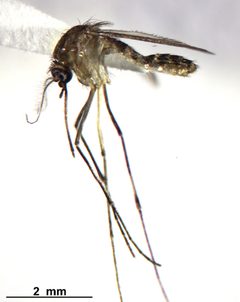
Culex nigripalpus, commonly known as the Florida SLE mosquito, is a medium-sized, dark-colored blood-feeding mosquito and a significant in subtropical regions. It serves as the primary enzootic vector of Saint Louis (SLE) virus to wild birds and the primary vector to humans in Florida. The has been demonstrated capable of transmitting West Nile virus, virus, , and . Its habit of feeding on both birds and mammals gives it substantial potential for zoonotic transmission from birds to humans.
Pronunciation
How to pronounce Culex nigripalpus: /ˈkjuːlɛks nɪˌɡrɪˈpælpəs/
These audio files are automatically generated. While they are not always 100% accurate, they are a good starting point.
Identification
Distinguished from similar Culex by its dark coloration and medium size. Definitive identification requires examination of genitalia or other taxonomic characters not detailed in general sources. In Florida, it is recognized as a significant species requiring surveillance.
Images
Appearance
Medium-sized, dark-colored mosquito. Specific morphological details distinguishing it from are not detailed in available sources.
Habitat
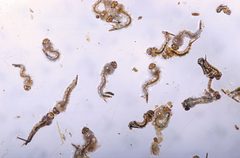
Larvae develop in freshwater including semi-permanent or permanent marshes, ditches, retention ponds, and grassy pools. Females preferentially lay in freshly flooded ditches. occupy diverse environments including urban, suburban, and rural habitats, with demonstrated habitat-dependent usage patterns.
Distribution
Widespread across the Americas from the southern United States through the Caribbean, Central America, and South America. Documented in: Anguilla, Bahamas, Barbados, Belize, Brazil, Colombia, Rica, Cuba, Dominica, Dominican Republic, Ecuador, El Salvador, French Guiana, Grenada, Guadeloupe, Guatemala, Guyana, Haiti, Honduras, Jamaica, Martinique, Mexico, Montserrat, Nicaragua, Panama, Paraguay, Peru, Puerto Rico, Saint Lucia, Saint Vincent and the Grenadines, Suriname, Trinidad and Tobago, United States, Venezuela, and Virgin Islands. In the United States, occurs from Texas to North Carolina in warm, humid coastal and in the Mississippi River basin as far north as Kentucky. First recorded in Davidson County, Tennessee in 2020.
Seasonality
Active year-round in subtropical regions. Blood-feeding shows seasonal patterns with proportional increase in mammalian feeding in early summer, reaching maximum between July and October, followed by shift back to avian dominating during winter and spring. No apparent seasonal shift in host selection observed in some , suggesting geographic variation.
Diet
females blood-feed on mammals, birds, and reptiles. Ectothermic (mostly reptiles) utilized at much higher ratio than previously reported. Sugar-feeding on nectar occurs; sugar-fed females show significantly greater host-seeking and biting responsiveness than unfed individuals. Host preference shifts with nutritional state: unfed females prefer nectar odors over host odors except when nectar odor is weak, switching to host preference after sugar feeding. Larvae filter feed in aquatic environments.
Host Associations
- Mammals - blood Preferred in rural ; seasonal increase in summer-fall
- Birds - blood in winter-spring; enzootic SLE virus
- Reptiles - blood Ectothermic utilized at much higher ratio than previously reported
- Humans - blood Used less frequently than by Culex quinquefasciatus; SLE virus transmission
Life Cycle
Complete with , larval, pupal, and stages. Larvae develop in freshwater aquatic . and show rhythms. Adult females require blood meals for egg production; ovarian follicle development to resting stage requires feeding. Wing length and lipid reserves influenced by larval rearing conditions, with crowding reducing adult size and energy reserves.
Behavior
Females exhibit -dependent selection: significantly more mammalian hosts in rural habitats versus similar mammalian/avian ratio in urban habitats. Demonstrates biphasic feeding pattern with seasonal shift between avian and mammalian hosts. Sugar-feeding reversibly elevates host responsiveness; starvation reverts females to sugar preference. Field evidence indicates multiple host contacts during single blood-feeding events. Oviposition occurs in freshly flooded habitats.
Ecological Role
Primary enzootic of Saint Louis virus to wild birds and primary vector to humans in Florida. Bridge vector facilitating zoonotic transmission from birds to humans due to mixed -feeding habits. Susceptible to Culex nigripalpus (CuniNPV), which has been investigated as a potential agent. influenced by rainfall patterns.
Human Relevance
Major public health concern in Florida and subtropical regions as principal of Saint Louis virus. Capable of transmitting West Nile virus, virus, , and . Subject to surveillance and management efforts due to arboviral transmission risk. Used as sentinel for monitoring mosquito-borne risk in urban and suburban environments.
Similar Taxa
- Culex quinquefasciatusSimilar size and preferences; distinguished by usage patterns—Cx. nigripalpus uses humans less frequently and shows different habitat-dependent host selection
- Culex pipiensOverlapping distribution in North America; Cx. nigripalpus prefers freshly flooded and shows distinct seasonal -shifting
- Culex restuansSympatric in eastern North America; field evidence shows both demonstrate multiple contacts during blood feeding, requiring careful differentiation
More Details
Vector Competence
Experimentally demonstrated capable of transmitting West Nile virus. Primary natural of Saint Louis virus in Florida, with established role in both enzootic bird-to-bird and bird-to-human transmission cycles.
Nutritional Ecology
Larval nutrition affects -seeking : restricted larval diet through crowding reduces adult wing length and lipid reserves, subtly influencing blood-feeding choices. Adult sugar-feeding is prerequisite for optimal host-seeking and biting responsiveness.
Virus Interactions
Subject to by Culex nigripalpus (CuniNPV), a with distinctive organization lacking many genes conserved in other baculoviruses, suggesting large evolutionary distance from lepidopteran baculoviruses.
Sources and further reading
- BugGuide
- Wikipedia
- GBIF taxonomy match
- iNaturalist taxon
- NCBI Taxonomy
- Catalogue of Life
- Are Culex Mosquitoes Potential Vectors of the Zika Virus? | Bug Squad
- Breaking News: Zika Virus Found in Wild-Caught Culex | Bug Squad
- Even at the Zoo, Mosquitoes Favor Local Wild Birds for Meals
- Mosquito redux - Culicidae — Bug of the Week
- Unique Egg-Laying Behavior Re-Discovered in Culex Mosquito Species
- Bloodsuckers in the basement: Subterranean mosquito, Culex pipiens form molestus — Bug of the Week
- The Florida SLE Mosquito, Culex (Culex) nigripalpus Theobald (Insecta: Diptera: Culicidae)
- Habitat-Specific Host Selection Patterns of Culex quinquefasciatus and Culex nigripalpus in Florida
- Proteins Associated with Culex nigripalpus Nucleopolyhedrovirus Occluded Virions
- Genome Sequence of a Baculovirus Pathogenic for Culex nigripalpus
- Studies on mosquitoes (Diptera: Culicidae) and anthropic environment: 10- survey of adult behaviour of Culex nigripalpus and other species of Culex (Culex) in South-Eastern Brazil
- Biology Of Culex Nigripalpus Theobald (Diptera: Culicidae)1: Part 1: Effects of Rearing Conditions on Growth and the Diurnal Rhythm of Pupation and Emergence
- Field Evidence for Multiple Host Contacts During Blood Feeding by Culex tarsalis, Cx. restuans, and Cx. nigripalpus (Diptera: Culicidae)
- Larval and adult nutrition effects on blood/nectar choice of Culex nigripalpus mosquitoes
- Sexual Behavior of Mosquitoes. 3. Age Dependence of Insemination of Culex nigripalpus and C. pipiens quinquefasciatus1 in Nature
- The Biology Of Culex Nigripalpus Theobald (Diptera: Culicidae)1 Part 2. Adult Characteristics at Emergence and Adult Survival without Nourishment
- Quantitative Bionomics of Culex Nigripalpus (Diptera: Culicidae) Populations In Florida: 2. Distribution, dispersal and survival patterns1
- Influence of Rainfall on Culex nigripalpus (Diptera: Culicidae) Blood-Feeding Behavior in Indian River County, Florida
- Culex nigripalpus : Seasonal Shift in the Bird-Mammal Feeding Ratio in a Mosquito Vector of Human Encephalitis