
Chironomus plumosus
Linnaeus, 1758
buzzer midge
Chironomus plumosus, commonly known as the buzzer , is a nonbiting midge distributed throughout the Northern Hemisphere. are known for forming large mating swarms during spring and summer. The species is part of a sibling- that includes C. muratensis and C. nudiventris, which cannot be morphologically distinguished from C. plumosus in adult form. The larvae, often called bloodworms due to their red coloration, are important food sources for fish and other aquatic .
Pronunciation
How to pronounce Chironomus plumosus: /ˌkɪrɒˈnoʊməs ˈpluːməsəs/
These audio files are automatically generated. While they are not always 100% accurate, they are a good starting point.
Identification
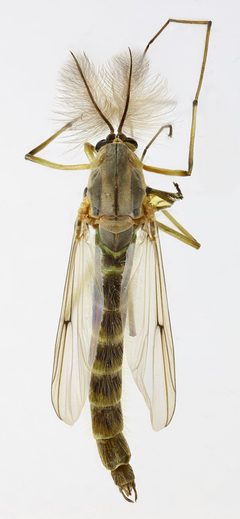
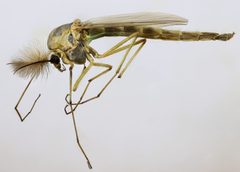
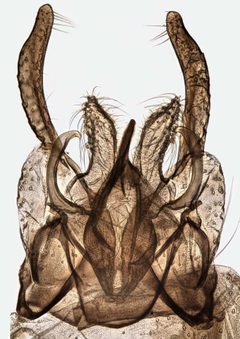
can be distinguished from similar by the combination of pale green body coloration, brown legs, and the dark brown band at the end of each abdominal segment. Males are readily identified by their feathery . However, C. plumosus cannot be reliably distinguished from its C. muratensis and C. nudiventris based on morphological characters alone; cytogenetic or molecular methods may be required. The larvae are recognized by their red coloration (though variable) and tube-dwelling in sediments.
Images
Habitat
Aquatic environments including lakes, ponds, and slow-moving waters. Larvae inhabit benthic sediments, constructing silken tubes in which they reside. Found in eutrophic woodland ponds and large freshwater lakes. Distribution within water bodies is aggregated, influenced by substrate characteristics and food availability.
Distribution
Occurs throughout the Northern Hemisphere. Documented from Europe (Denmark, Norway, Sweden), North America (Lake Winnebago, Wisconsin), and Asia. Part of a sibling- with intermediate distribution patterns between European and Siberian in the Caucasus region.
Seasonality
are active during spring and summer. Males form mating swarms during this period. Larvae are present year-round in aquatic sediments, with occurring in spring and summer when adults emerge.
Diet
Larvae feed on organic debris and , functioning as . do not feed.
Life Cycle
Females lay masses in water; eggs grow and sink to the bottom. Larvae remain in benthic silken tubes, feeding and developing through multiple instars. Final-instar larvae pupate and drift toward the water surface to emerge as . Adults do not feed and have a short lifespan focused on .
Behavior
Larvae exhibit intermittent tube irrigation for respiration, alternating with filter-feeding and periods of rest. Respiratory behavior increases and feeding decreases as dissolved oxygen concentrations drop; below 10% air saturation, larvae cease feeding entirely. Larvae can enter immobility under anaerobic conditions. Pupating larvae drift toward the water surface, making them vulnerable to . Males form mating swarms that can be a nuisance to humans, though do not bite.
Ecological Role
Larvae serve as important prey for fish and numerous aquatic including , , diving beetles, water bugs, newts, toads, and birds. Function as benthic , processing organic matter in sediments. Form a significant component of aquatic , linking benthic productivity to higher .
Human Relevance
mating swarms can be perceived as a nuisance, though adults do not bite and pose no health risk. Larvae are important food for sport fish and in aquaculture. Used as a model organism in aquatic toxicology studies, particularly for assessing effects of pollutants such as phthalic acid esters. The has been studied extensively for respiratory physiology involving hemoglobin function.
Similar Taxa
- Chironomus muratensis morphologically indistinguishable from C. plumosus in stage; requires cytogenetic or molecular methods for differentiation.
- Chironomus nudiventris that cannot be distinguished from C. plumosus based on morphological characters alone.
- Chironomus utahensisRelated that forms massive mating swarms; distinguished by geographic range and genetic differences.
More Details
Hemoglobin Function
Larvae possess hemoglobin that serves multiple functions: maintains filter-feeding activity at low oxygen concentrations, enables oxygen transport during pauses in tube irrigation, and accelerates recovery from anaerobic conditions. The blood pigment holds approximately a 9-minute oxygen store for resting animals.
Sibling Species Complex
C. plumosus belongs to a cryptic including C. muratensis and C. nudiventris. These are reproductively isolated but morphologically identical, presenting challenges for identification and studies of distribution and .
Sources and further reading
- BugGuide
- Wikipedia
- GBIF taxonomy match
- iNaturalist taxon
- NCBI Taxonomy
- biodiversity | Blog - Part 35
- Uncategorized | Blog - Part 13
- Hollywood is for the Bugs
- The Biology of Chironomus plumosus (Diptera: Chironomidae) in Lake Winnebago, Wisconsin1
- Some effects of two phthalic acid esters on the life cycle of the midge (Chironomus plumosus)
- Tube Formation and Distribution of Chironomus Plumosus L. (Diptera : Chironomidae) in a Eutrophic Woodland Pond
- The Function of Haemoglobin in Chironomus Plumosus Under Natural Conditions
- Chironomus sp. J - an elusive species from the Chironomus plumosus (Linnaeus, 1758) sibling-species group (Diptera, Chironomidae).