
Chaoborus
Lichtenstein, 1800
glassworm, phantom midge, lake fly
Species Guides
8- Chaoborus albatus(phantom midge)
- Chaoborus astictopus(Clear Lake gnat)
- Chaoborus cooki
- Chaoborus festivus(phantom midge)
- Chaoborus flavicans(phantom midge)
- Chaoborus maculipes(phantom midge)
- Chaoborus punctipennis(phantom midge)
- Chaoborus trivittatus(phantom midge)
Chaoborus is a of non-biting midges in the Chaoboridae, distributed in lakes worldwide. The larvae, known as glassworms, are nearly transparent and inhabit the water column, often performing diel vertical . are short-lived, typically surviving less than ten days to mate and lay . The genus comprises approximately 44 with variable , including and some forms.
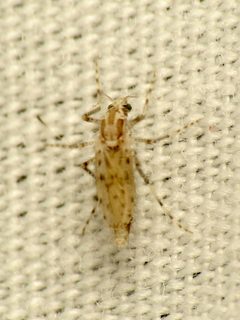
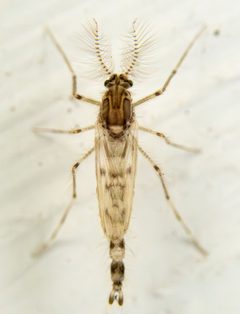
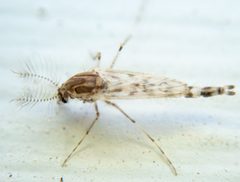
Pronunciation
How to pronounce Chaoborus: //keɪˈɒbɔːrəs//
These audio files are automatically generated. While they are not always 100% accurate, they are a good starting point.
Identification
Larvae distinguished from mosquito larvae (Culicidae) by transparency, paired air sacs, and modified prehensile used in prey capture. Mosquito larvae possess a respiratory siphon and lack the conspicuous air sacs. Chaoborus larvae are also separable from other aquatic dipteran larvae by their nearly complete transparency and distinctive buoyancy-mediated vertical positioning. -level identification of larvae requires examination of capsule and measurements; C. americanus and C. trivittatus, for example, differ in head length and instar progression patterns.
Images
Habitat
Primarily lacustrine. Larvae occupy the water column of lakes, from surface waters to depths exceeding 70 m in some systems. Distribution within lakes varies by and ontogenetic stage: smaller species and early instars often restricted to upper water layers (epilimnion), while larger individuals and certain species occupy deeper zones (hypolimnion) during daylight hours. Can occur in sediments of anoxic deep waters. terrestrial but closely associated with lake environs.
Distribution
in lakes worldwide. Documented from North America (Canadian Shield lakes, British Columbia), Europe (Czech Republic, Scandinavia), and Africa (Lake Malawi, Lake Victoria—where notably absent from Lake Tanganyika). GBIF records indicate presence in Colombia, Denmark, Norway, and Sweden.
Seasonality
Timing of and generally follows ice thaw and rising water temperatures in temperate regions. Most with single-year cycles; some exhibit two-year times. Adults short-lived, typically active for less than ten days.
Diet
Larvae are , capturing prey with modified prehensile . Primary prey includes copepods and cladocerans; copepods are believed preferred when available. Prey selection is opportunistic based on encounter within the strike zone rather than active pursuit. Prey size limits determined by and dimensions vary among . Larvae have been observed to prey on mosquito larvae in substantial numbers.
Life Cycle
Development includes four larval instars, a brief pupal stage, and short-lived phase. Majority of lifespan spent as larvae. Instar duration and vertical distribution vary among : C. americanus completes development in one year with all instars in upper 5 m; C. trivittatus requires two years, with third and fourth instars occurring below 5 m depth. timing environmentally dependent, typically post-thaw in temperate zones.
Behavior
Performs diel vertical : ascending to surface waters at dusk, descending to deeper at dawn. Migration depth influenced by fish risk; presence of fish triggers downward displacement via chemical detection rather than visual or mechanical cues. Smaller occupy shallower daytime depths than larger . Horizontal distribution affected by wind-induced advective currents: evening onshore transport via surface currents, offshore return via nighttime cooling-induced downwelling. do not feed; adults do not bite mammals.
Ecological Role
Important of zooplankton, particularly copepods and cladocerans, and significant predator of mosquito larvae. Serves as prey for fish, linking pelagic and benthic . Vertical transports nutrients and energy between hypolimnion and epilimnion. Strong acoustic target for high-frequency hydroacoustic surveys, enabling quantitative assessment.
Human Relevance
Collected as fish food and sold commercially; easily maintained in cold, aerated water. In African Great Lakes (Malawi, Victoria), dense swarms harvested for human consumption as kungu cakes, biscuits, or burgers—a protein-rich traditional food. Historical account by David Livingstone (1865) described the taste as 'not unlike caviare.' Adults do not bite or .
Similar Taxa
- Culicidae (mosquito larvae)Larvae occupy similar and share general body form. Distinguished by mosquito larvae's respiratory siphon, lack of transparency, absence of paired air sacs, and filter-feeding rather than predatory .
- CorethrellaAnother chaoborid with transparent larvae; separation requires examination of specific morphological characters not detailed in available sources.
More Details
Acoustic detectability
Fourth instar larvae and pupae produce significant acoustic backscatter at 120–200 kHz, enabling quantitative hydroacoustic assessment. Target strength ranges approximately -70 to -60 dB at 120 kHz. Earlier instars do not generate detectable echoes.
Life cycle variation
Coexisting may exhibit divergent times (one versus two years) and depth distributions, facilitating stable coexistence through temporal and spatial partitioning.
Sources and further reading
- BugGuide
- Wikipedia
- GBIF taxonomy match
- iNaturalist taxon
- NCBI Taxonomy
- Catalogue of Life
- COMPARATIVE BIOLOGY OF CHAOBORUS AMERICANUS AND CHAOBORUS TRIVITTATUS IN EUNICE LAKE, BRITISH COLUMBIA1
- High frequency echography: Quantitative relation between echogram density and vertical distribution of Chaoborus larvae
- Habitat separation among three temperate Chaoborus species
- Chaoborus behavioural responses to changes in fish density
- Ontogenetic shifts in the migratory behavior of Chaoborus flavicans Meigen: field and experimental evidence
- Quantification of Chaoborus and small fish by mobile upward-looking echosounding