
Milichiella lacteipennis
(Loew, 1866)
freeloader fly
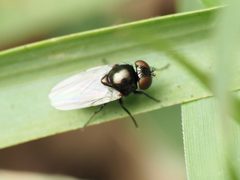
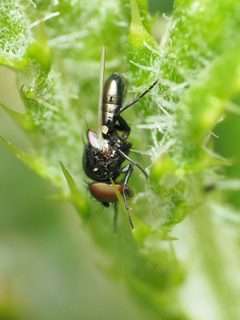
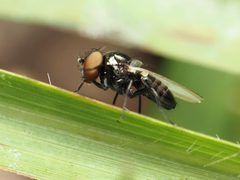
Milichiella lacteipennis is a small, dark-colored fly in the Milichiidae, commonly known as freeloader flies. The has a distribution, having been recorded from the Galápagos Islands, Japan, Madeira, Hawaii, and Argentina. It is a kleptoparasite that feeds on fluids from prey captured by predatory insects, particularly heteropteran . The species was described by Loew in 1866.
Pronunciation
How to pronounce Milichiella lacteipennis: //mɪˌlɪkiˈɛl.lə lækˌtaɪˈpɛnˌnɪs//
These audio files are automatically generated. While they are not always 100% accurate, they are a good starting point.
Identification
Distinguished from other Milichiidae by subtle morphological features established in Loew's 1866 description; precise diagnostic characters require examination of or specialized taxonomic literature. Separation from likely relies on wing venation, chaetotaxy, and genitalic structures typical of the .
Images
Appearance
Small, dark-bodied fly. Specific morphological details beyond general characteristics are not documented in available sources.
Habitat
Found in diverse environments including agricultural fields (soybean in Argentina), sand prairies, and areas where predatory insects are active. Specific microhabitat preferences are not documented.
Distribution
: recorded from Galápagos Islands, Japan, Madeira (Portugal), Hawaii (USA), and Argentina (Chaco Province, Buenos Aires Province).
Diet
Kleptoparasitic; feeds on and other fluids from prey captured by predatory insects, particularly stink bugs (Pentatomidae) and leaf-footed bugs (Coreidae) being consumed by reduviid assassin bugs and spiders.
Host Associations
- Piezodorus guildinii - kleptoparasitismObserved feeding on this prey captured by Apiomerus flavipennis in Argentina
- Nephila clavipes - kleptoparasitismDocumented feeding on prey captured by this orb-weaving spider in Florida
Behavior
Engages in kleptoparasitism, congregating around and their prey. Flies actively crawl upon both the predator and prey to access fluids. Attracted to defensive chemical secretions () of heteropteran prey, which serve as . Tolerates disturbance, quickly returning after being dislodged by the predator.
Ecological Role
Kleptoparasite that exploits -prey interactions; may facilitate mate location through at food sources. Chemical cues from prey defensive secretions enable efficient resource location.
Human Relevance
Minor economic significance as a natural history curiosity; studied for its chemical and kleptoparasitic . No documented direct impact on agriculture or human health.
Similar Taxa
- Chloropidae (Oscinellinae)Similar kleptoparasitic and ; co-occurs at -prey events but distinguished by smaller size, brown coloration, and -level morphological characters
- Other MilichiidaeShares -level kleptoparasitic habits; -level separation requires examination of wing venation, chaetotaxy, and genitalic structures
More Details
Chemical ecology
Attraction to prey is mediated by specific components of defensive sprays in pentatomid and coreid , as demonstrated experimentally by Eisner et al. (1991). This represents one of the clearest examples of kleptoparasites exploiting -prey chemical signaling.
Behavioral observations
In field observations in Argentina, individuals were seen crawling over an Apiomerus flavipennis assassin bug and its Piezodorus guildinii prey, tolerating periodic dislodgement by the 's leg-wiping movements.